Where Travel eSIMs Are Blocked in 2026: Turkey, Kuwait, China and India Explained
Turkey blocks 30+ eSIM providers, Kuwait moved against travel eSIMs in March 2026, and China still has no consumer eSIM. Here is what actually stops working — and what doesn't.
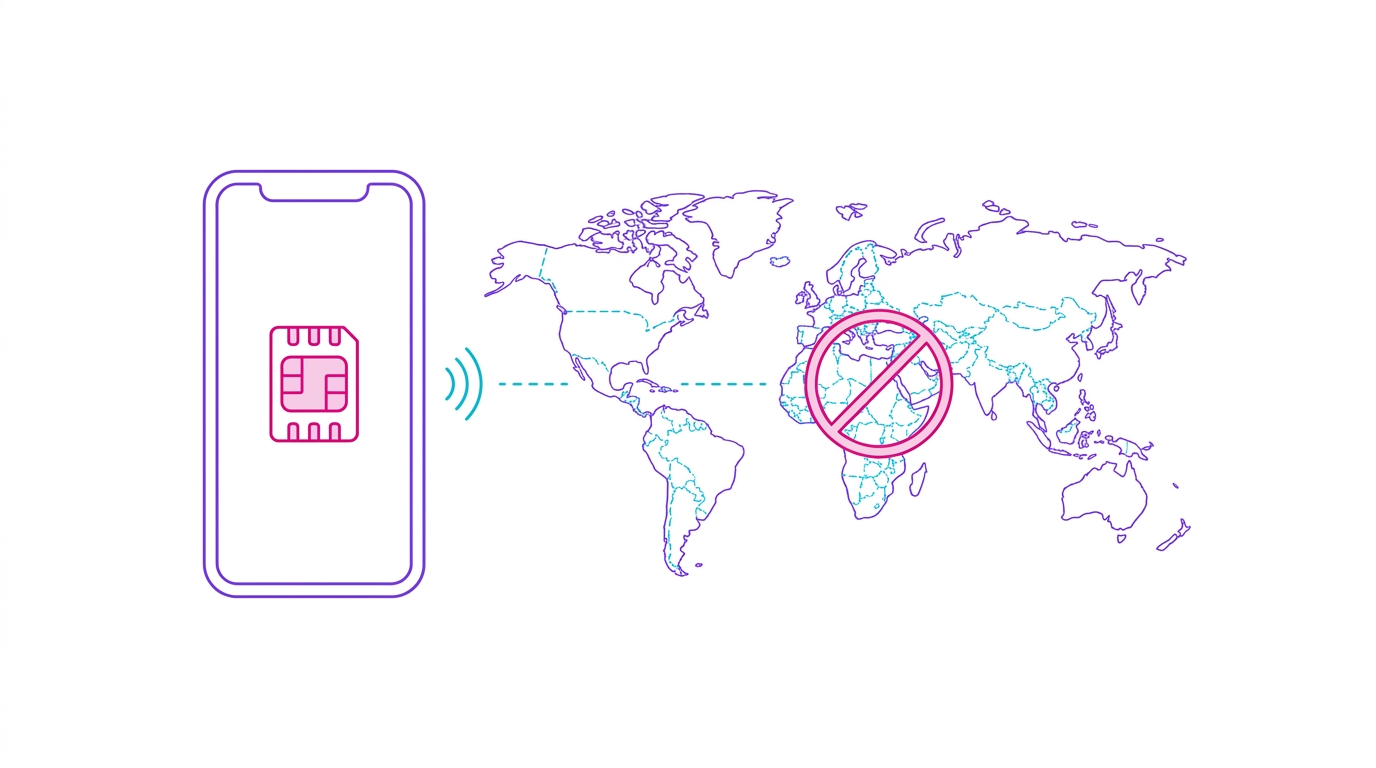
Travel eSIMs are now mainstream — Juniper Research expects roughly 1.5 billion eSIM connections worldwide in 2026, about 30% more than the year before. But the map is not uniform. A small and growing group of countries has moved to block, restrict or simply never enable the technology, and in August 2026 the practical question for travelers is no longer "does my phone support eSIM" but "does my destination".
Here is what has actually changed, country by country, and what it means the moment you land.
Turkey: the broadest block in the world
Turkey remains the only country to have implemented a broad block on international eSIM platforms. Since July 2025, the Turkish telecom regulator BTK has restricted in-country access to the websites and apps of Airalo, Holafly and more than 30 other travel eSIM providers.
The critical nuance — and the one most travelers get wrong — is that this is a distribution block, not a network block. Turkey is not jamming eSIM profiles. It is blocking the storefronts. A profile you bought, downloaded and installed before arriving in Turkey keeps working normally on Turkish networks. What you cannot do is land at Istanbul Airport with no data, open a provider's app, and buy one.
That single detail turns a trip-ruining problem into a five-minute pre-flight task.
Kuwait: new restrictions as of March 2026
As of March 2026, Kuwait has implemented measures to restrict or prohibit the use of travel eSIMs, and several providers were asked to cease selling eSIMs to travelers with immediate effect. This is the newest entry on the list and the one with the least public documentation, which is exactly why it deserves attention: coverage pages that were accurate in 2025 may still be listing Kuwait as fully supported.
If Kuwait is on your itinerary in 2026, treat provider coverage claims as something to verify at purchase time rather than assume.
China: no ban, but no consumer eSIM either
China is the most misunderstood case. There is no explicit statutory ban on eSIM in China. The restriction works through regulatory design rather than prohibition: China's real-name SIM registration framework was built around physical SIM cards, and Chinese carriers were never directed or incentivised to build the infrastructure that would let domestic consumer smartphones activate eSIM profiles inside it. That is why phones sold in mainland China ship without eSIM support at all.
For a visitor, the outcome is counterintuitively good. A travel eSIM installed on a phone bought outside China stays installed and functional in China, as long as your provider holds a roaming agreement with a Chinese domestic carrier. You get mobile data. What you do not get is the ability to walk into a Chinese carrier shop and buy a local eSIM.
India: legal, but with a paperwork wall on local plans
India allows eSIM, but every foreign visitor buying a local Indian SIM or eSIM must complete KYC registration — a legal requirement enforced under Indian telecom rules. You need your passport, a valid Indian visa and address proof (a hotel booking confirmation is generally accepted), and activation typically takes between 2 and 24 hours after you submit documents.
International travel eSIM providers operating on roaming agreements sidestep that queue: they work on arrival with no local eKYC step. For a two-week trip, waiting a day for a local plan to activate is often the worse trade.
The pattern behind the restrictions
Look at all four and a shape emerges. None of these governments objects to eSIM as a technology. What they object to is a foreign-issued connectivity profile that activates inside their borders without passing through their identity-verification and lawful-intercept plumbing. Turkey and Kuwait attack the point of sale. China simply never built the on-ramp. India built the on-ramp and put a passport check at the entrance.
That framing is useful because it predicts behaviour: restrictions tend to hit buying inside the country far more often than using something you already own.
What this means for your next trip
Four rules cover almost every case in 2026:
- Buy and install before you fly. Install the profile at home over Wi-Fi. In Turkey this is the entire difference between working and not working, and it costs nothing anywhere else.
- Screenshot your QR code and activation details. If you cannot reach the provider's site from inside the country, you need the credentials offline.
- Check restriction status at purchase, not from a blog post. Kuwait changed in March 2026. Lists go stale fast.
- Prefer a regional or global profile for multi-country itineraries that touch a restricted market, so a single blocked storefront does not strand you mid-trip.
Providers like HOLASIM built around the buy-before-you-board model handle these markets better than in-destination purchases do, precisely because the profile is already on your phone before any regulator's block is relevant.
If you have never installed one, our step-by-step travel eSIM setup guide walks through the whole process, and it is worth reading our roundup of the five eSIM scams travelers keep falling for before you buy from an unfamiliar seller in a restricted market — blocked storefronts are exactly where lookalike sites thrive.
The short version: in 2026 the eSIM world is still overwhelmingly open. Four countries need a plan. Making that plan takes ten minutes before takeoff.