IFA 2026: 5G Dongles and Routers Now Ship With an eSIM Already Loaded
At IFA 2026 in Berlin, Acer showed a 5G dongle with a preloaded eSIM profile, tri-SIM flexibility and 3.27 Gbps peak speeds. Travel connectivity is moving off the phone.
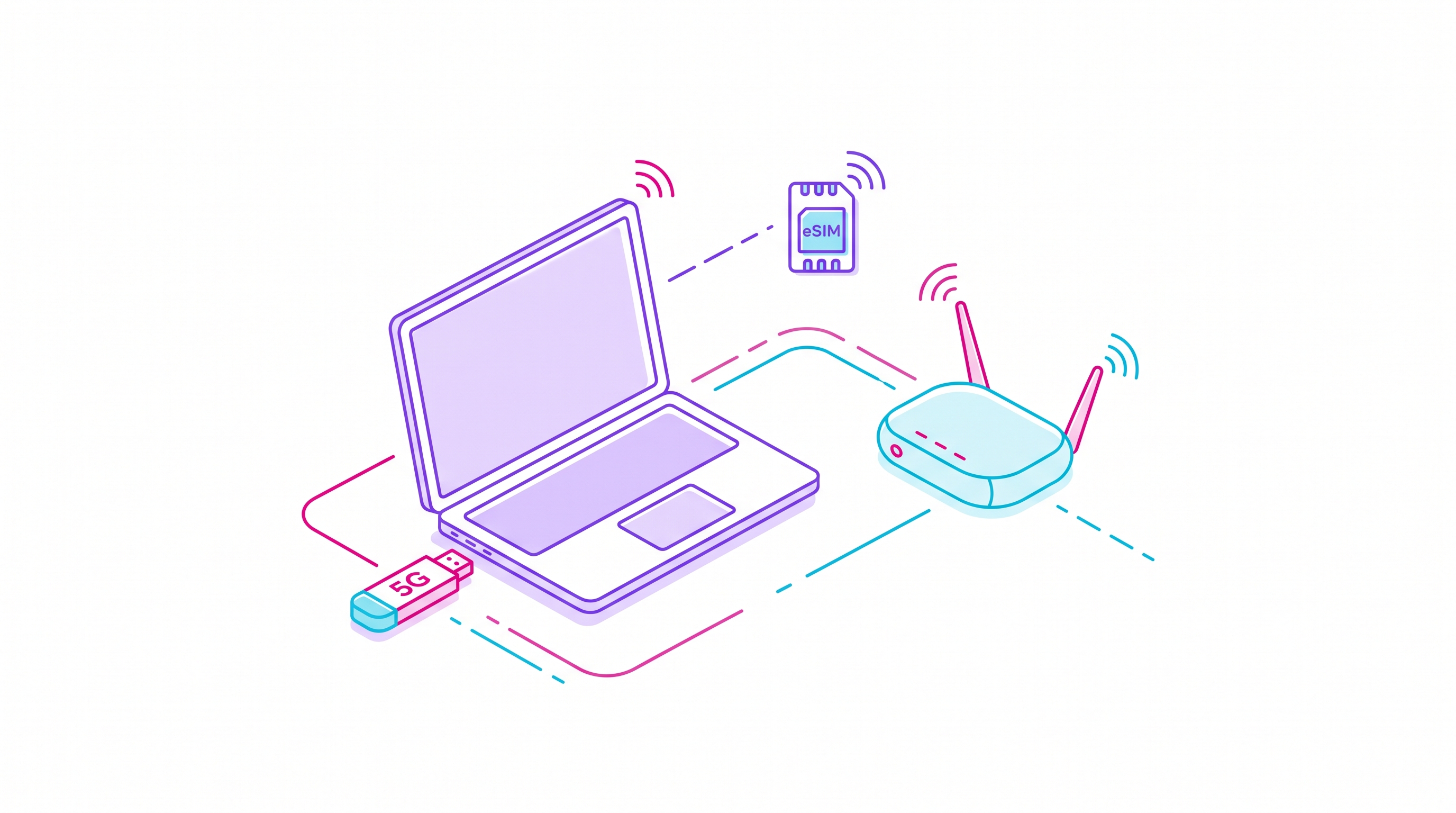
The most useful travel connectivity news out of IFA 2026 in Berlin this week did not come from a phone. It came from a dongle.
Acer used its next@acer press conference at the show to announce the Connect D5P, a plug-and-play 5G dongle for laptops and other computing devices, alongside the Connect X6ES, a 5G CPE router that combines Wi-Fi 6E with a cellular uplink and intelligent failover. Neither is glamorous hardware. Both point at something that matters if you work while you travel: the assumption that your laptop borrows connectivity from your phone is quietly being retired.
What Acer actually announced
The Connect D5P is the more interesting of the two for travelers. Three things stand out from the spec sheet.
It ships with an eSIM profile already loaded. You plug it in and it has connectivity out of the box, without the usual routine of scanning a QR code, downloading a profile, and hoping the activation server cooperates on hotel Wi-Fi. For a category where a meaningful share of support tickets are activation failures, a preloaded profile removes the worst step.
It supports three kinds of SIM. Acer calls it tri-SIM flexibility: eSIM, nano SIM and vSIM all work. That combination is deliberate. eSIM for travel data packs bought in an app, nano SIM for markets or corporate plans that still hand out plastic, vSIM for the cloud-provisioned profiles some enterprise fleets use. A device that accepts all three does not become useless when one path is blocked - and eSIM is blocked or restricted in more places than most people assume.
The peak speeds are real 5G, not LTE with marketing. Acer quotes up to 3.27 Gbps in 5G Standalone mode and up to 2.77 Gbps in Non-Standalone. You will never see those numbers on a hotel network in practice, but the gap between SA and NSA figures tells you the modem is a current-generation part rather than a repackaged older one.
The Connect X6ES router sits in a different slot: a device for a rented apartment, a pop-up office, or a family that wants one connection shared across several laptops rather than five separate data plans.
Why this category is growing now
Two forces are pushing connectivity hardware away from the phone.
The first is that tethering is a bad load-bearing solution. It cooks your phone battery, it throttles on many carrier plans once you cross a hotspot cap, and it fails at the exact moment you need both devices - a video call on the laptop while you are also using the phone for directions or a verification code.
The second is that eSIM has made standalone cellular hardware genuinely easy to provision. A travel router or dongle used to mean buying a local SIM at every border. Now it means opening an app. That shift is what has taken eSIM out of the phone and into a much wider range of devices - a trend we covered in eSIM is leaving the phone: laptops, tablets and travel routers in 2026.
There is a cost angle too. Travel eSIM data has become dramatically cheaper than carrier roaming: 1 GB packs now routinely sell for under $5, against $10 to $12 per day for a US carrier international day pass. If a dongle lets a laptop use the same cheap data pack the phone uses, the pass becomes harder to justify. Our eSIM versus roaming cost comparison runs the arithmetic for a typical two-week trip.
What to check before you buy travel connectivity hardware
A dongle or travel router is only worth carrying if it clears a few practical tests.
- Band support for where you are going. A device tuned for European and North American 5G bands may drop to slow LTE in parts of Asia or Latin America. Check the band list against your destination, not against the headline speed.
- Whether the preloaded eSIM is a trial or a lock. A bundled profile is convenient, but confirm you can add your own eSIM alongside it. A device that only accepts its vendor's data plan is a subscription, not hardware.
- Hotspot rules on your data plan. Some plans, including some travel eSIMs, restrict or throttle tethering. Read the fine print before assuming a router will work with the pack you already own.
- Power draw. A dongle drawing power from your laptop shortens your working session. A battery-powered router adds weight but keeps the laptop alive.
- Whether you need it at all. For one laptop and light use, a second eSIM profile installed directly on the laptop - most 2025 and 2026 business machines support one - is lighter and cheaper than any accessory.
The bigger picture
IFA is a consumer electronics show, so the framing was about working and staying connected on the move. Strip away the marketing and the signal is straightforward: connectivity is becoming a feature of every device rather than something one device shares with the rest.
For travelers, that mostly changes the shopping list rather than the strategy. The strategy still starts with buying data before you fly, at travel eSIM prices instead of roaming prices - HOLASIM and similar providers sell country and regional packs that install in minutes and work on phones, tablets, and increasingly the hardware announced this week in Berlin.
The dongle is not the story. The fact that it arrives already connected is.