eSIM Is Leaving the Phone: Laptops, Tablets and Travel Routers in 2026
What happened
The eSIM story of the last three years was a phone story. That is ending. Industry forecasts from ABI Research put eSIM-enabled device shipments above 633 million units in 2026, up from roughly 403 million consumer devices plus 140 million IoT devices in 2025. Smartphones still dominate the mix — about 74% of eSIM shipments in 2025 — but the growth is increasingly coming from everything that is not a phone.
That matters for travelers for a blunt reason: the second device you carry is usually the one that ruins your data plan.
Where the growth actually is
The device categories moving fastest are not the ones you would guess:
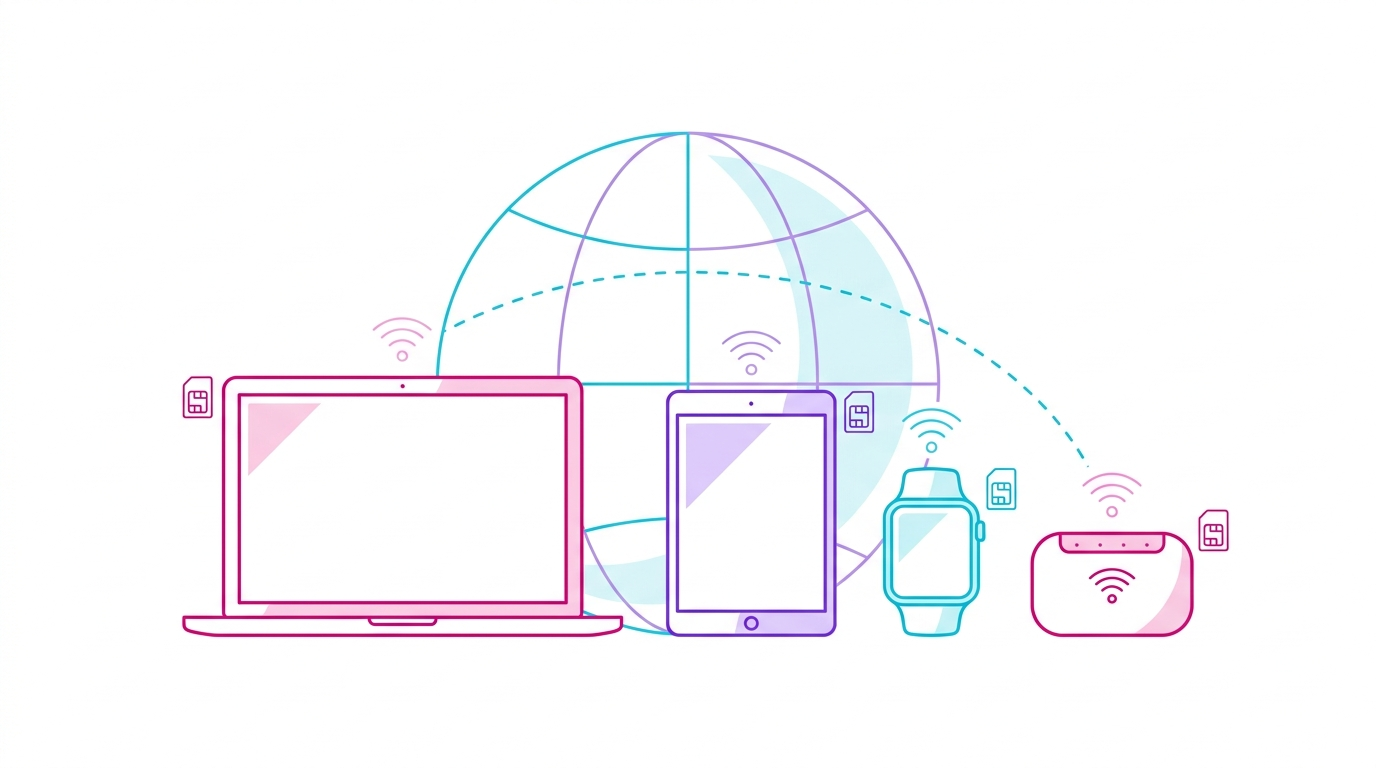
- Smartwatches are the most widely adopted non-phone eSIM device, with roughly a 41% ownership rate among surveyed users.
- Fitness trackers sit around 28%, and tablets around 23%.
- China Unicom, one of the largest operators in the world, has reported roughly 30× growth in tablet eSIM adoption and 10× growth in watch and IoT eSIM adoption — numbers that show how quickly a single market can flip once the devices ship with the hardware.
- Laptops are the quiet one. eSIM has moved from a business-fleet feature on a handful of ultrabooks to something showing up across more consumer models.
- Travel routers and portable hotspots are the newest arrivals: a pocket router with an eSIM slot means one plan can feed a laptop, a tablet and a partner''s phone at once.
Behind all of this sits GSMA SGP.32, the specification that made remote eSIM provisioning practical for devices without a touchscreen or a keyboard. If a smartwatch or a router can download a profile without a phone holding its hand, the whole category becomes sellable.
The other quiet shift: eSIM has stopped being a premium feature. It is now appearing on mid-range and budget handsets, which the GSMA has long identified as the real bottleneck for adoption.
Why this changes travel connectivity
Most travelers today solve connectivity once — for the phone — and then improvise for everything else. The improvising is where money leaks.
Tethering is the usual patch, and it is the weakest link. Hotspot allowances are where "unlimited" travel plans stop being unlimited. Carrier and provider plans routinely cap hotspot data at 5GB or similar and then throttle to 128 kbps, which is enough for email headers and nothing else. If your laptop is your job, tethering off a phone plan is a bet you will lose on day four.
Battery is the second cost. Running a phone as a hotspot in a foreign city, on an unfamiliar network, with the screen on for navigation, drains it fast — and a dead phone abroad is not a minor inconvenience when it holds your boarding pass, your maps and your two-factor codes.
A second cellular device removes both problems. A laptop with its own eSIM, or a travel router carrying the data plan for the whole group, changes the shape of the trip. It also changes what you should buy: instead of one plan sized for a phone, you want either a larger shared pool or a dedicated data-only plan per device.
What to do about it now
- Check what you already own. Many recent laptops, iPads and Android tablets have eSIM support that owners never activated. Look for "Cellular" or "Mobile data" in settings; if it exists, the hardware is there.
- Buy data-only plans for non-phone devices. They are usually cheaper than voice-capable plans, and a laptop or router does not need a phone number. Most travel eSIM providers, including HOLASIM, Airalo and Ubigi, sell data-only regional plans that install on any eSIM-capable device.
- Size the plan for the device, not the trip. A phone might use 500MB a day. A working laptop on video calls can use several gigabytes a day. These are not the same purchase.
- Consider one router instead of several eSIMs if you travel as a couple, a family or a small team. One regional plan feeding a travel router is often cheaper than three individual plans, and it keeps everyone on one bill.
- Verify the device is unlocked and eSIM-capable before you leave. This is where trips break. Laptop cellular modems are sometimes carrier-locked in ways owners never discover until they are abroad.
The bigger picture
The forecast for 2026 is not just more eSIMs — it is eSIM as an assumed feature rather than a spec-sheet bullet. Analysts and operators expect plans that adapt to usage in real time and deeper integrations with airlines, hotels and travel apps, so the profile arrives with the booking rather than as a separate errand.
For travelers the practical consequence is already here: connectivity is no longer a phone decision. Before your next trip, count your devices, then count your plans — and if the second number is smaller than the first, you are probably about to pay for it in throttled hotspot data. If you are still weighing plan shapes, our breakdown of eSIM-only phones in 2026 covers the device side of the same transition.