Free Starlink Wi-Fi Now Flies on 1,400+ Planes in 2026 — And What It Still Doesn't Fix
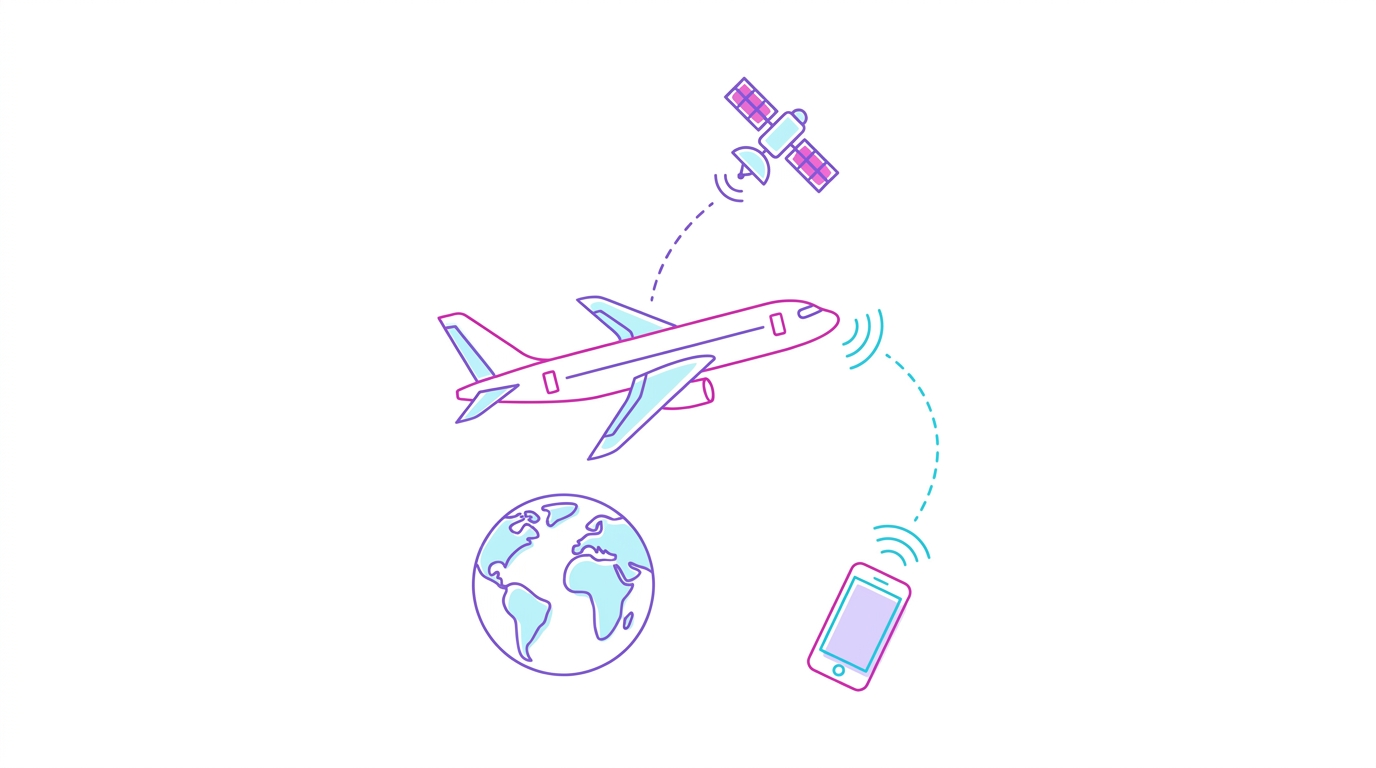
In-flight internet used to be the worst connection you paid the most for. In 2026 that inverted. As of August 2026, more than 40 commercial airlines have signed agreements with Starlink and more than 1,400 aircraft are already flying with low-orbit satellite Wi-Fi installed — most of them offering it free to passengers.
For travelers, this is the biggest jump in airborne connectivity since Wi-Fi appeared on planes at all. It also creates a strange new gap: your data works better at 35,000 feet than it does in the taxi from the airport.
What actually changed
Legacy in-flight Wi-Fi ran over geostationary satellites parked roughly 36,000 km above the equator. The physics were unforgiving: high latency, narrow capacity shared across a full cabin, and dead zones over oceans and polar routes. That's why messaging apps crawled and video calls were impossible.
Low-earth-orbit constellations sit hundreds of kilometres up instead of tens of thousands. Latency drops enough for video calls and cloud apps to behave normally, and capacity per aircraft rises by an order of magnitude. The practical result passengers notice: streaming works, video calls work, and the connection doesn't collapse when half the cabin logs on.
The airlines moving fastest
United Airlines has the most aggressive rollout, targeting Starlink on 1,000 aircraft by the end of 2026. It's free for all MileagePlus members.
Southwest Airlines began its free Starlink rollout in summer 2026 and plans to reach more than 300 aircraft by year-end. Free access is reserved for Rapid Rewards members.
Lufthansa Group is the most ambitious in Europe: free Starlink Wi-Fi across every member airline, with roughly 850 aircraft scheduled for installation by 2029. That covers Lufthansa, SWISS, Austrian Airlines, Brussels Airlines, ITA Airways, Edelweiss, Discover Airlines, Air Dolomiti, Lufthansa City Airlines and Eurowings. Its first Starlink-equipped Airbus A380 entered service in the last week of April 2026, the same week 25 of its Boeing 777s were already flying with the service.
Why "free" comes with conditions
Two catches are worth knowing before you count on it.
The first is loyalty gating. At both United and Southwest, free access is tied to membership in the airline's frequent-flyer programme. Signing up is free and takes a minute, but it has to happen before you board — the sign-up page itself often isn't reachable from the aircraft's captive portal.
The second is fleet coverage. "The airline has Starlink" and "your aircraft has Starlink" are different statements. With 1,400 aircraft equipped out of a global commercial fleet in the tens of thousands, most flights still don't have it. Retrofits are done aircraft by aircraft, usually starting with long-haul widebodies and newer narrowbodies. There is no reliable way to know at booking which tail number you'll get.
The gap nobody solved: the first hour on the ground
Here is the part that catches people out. You land with a working connection, the aircraft's Wi-Fi shuts off as the doors open, and you're back to whatever your phone can find on its own — which for most international travelers means either an expensive roaming day pass or nothing at all.
That first hour is exactly when connectivity matters most: confirming a ride, opening a boarding-pass-turned-hotel-address, sending a message so someone knows you landed. Airport Wi-Fi is inconsistent, frequently requires an SMS code you can't receive, and is a well-documented target for network-based attacks.
A travel eSIM is designed for precisely this window. You install the profile at home over your normal internet, arrive with it already provisioned, and it attaches to a local network as soon as you turn airplane mode off — before you reach the terminal. Providers like HOLASIM and the other major travel eSIM brands all sell this as a QR code or in-app activation you complete days in advance.
If you want the arithmetic on what that replaces, our breakdown of eSIM versus carrier roaming in 2026 compares the two side by side. And for the longer-term picture, satellite connectivity is also arriving on phones directly — we covered 5G non-terrestrial networks reaching consumer handsets earlier this year.
The practical checklist
- Join the airline's loyalty programme before departure if free Wi-Fi is gated behind it.
- Don't plan work around in-flight Wi-Fi you haven't confirmed for your specific aircraft.
- Install and activate a travel eSIM before you leave home, so the ground side is covered too.
- Download offline maps and boarding documents anyway. Redundancy is free.
Satellite Wi-Fi has made the flight the easy part of staying connected. The airport is now the hard part — and that's a problem you solve on the ground, before you take off.