eSIM vs Physical SIM Card for Travel: Pros, Cons, and When Each Wins
Should you stick to physical SIM cards or switch to digital eSIMs for your next trip? Discover the pros, cons, costs, and best options for international travel connectivity.
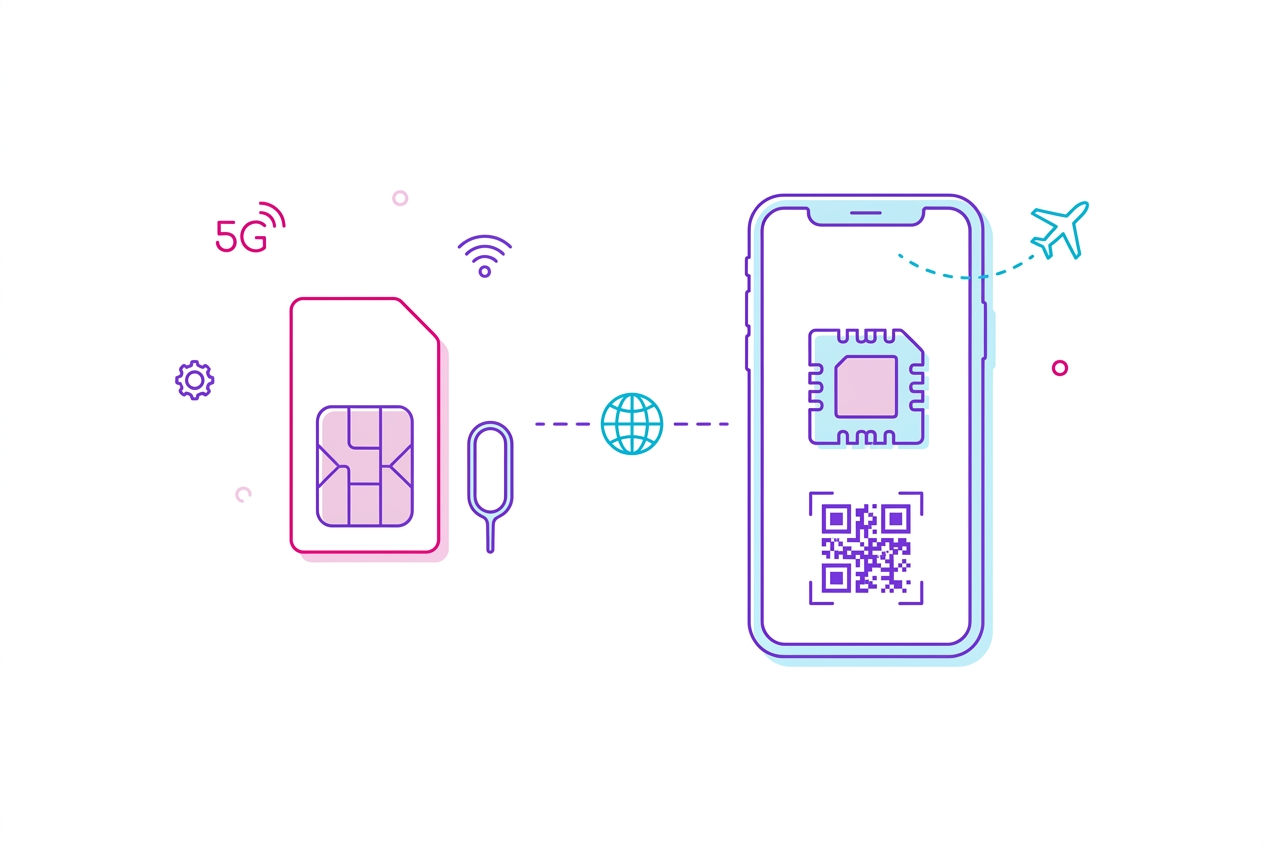
eSIMs win for convenience, speed, and safety because you can buy, install, and activate mobile data digitally in 200+ destinations without swapping tiny plastic cards, whereas physical SIMs win for legacy phones lacking eSIM hardware or rare remote markets where local prepaid SIMs offer cheaper physical options.
Summary
- Convenience: eSIMs eliminate airport queues and physical card swapping by letting you download digital profiles instantly.
- Dual SIM Security: Keep your main physical SIM in your phone to receive 2-factor authentication SMS codes while using an eSIM for low-cost international data.
- Pricing Parity: Global eSIM rates now start from as low as USD 1.70, making them highly competitive against local physical SIM cards.
- Hardware Limits: Physical SIM cards remain essential only for older smartphone models or budget devices that lack built-in eSIM chips.
Understanding the Basics: Physical SIM vs. eSIM
For decades, traveling abroad meant landing at your destination, standing in line at an airport kiosk, and using a paperclip to extract your primary SIM card—risking losing that tiny chip forever. A physical SIM is a removable plastic microchip containing your mobile subscriber identity.
An eSIM (embedded SIM) is a programmable chip built directly into your device's motherboard. Instead of inserting plastic, you simply scan a QR code or download a profile through an app to download network credentials digitally.
According to industry standards and our testing across top global networks, eSIM technology delivers identical data speeds (up to 5G) and coverage quality as standard physical SIM cards.
Pros and Cons of Physical SIM Cards
Reasons to Buy Physical SIM Cards
- Universal Compatibility: Works in virtually any unlocked mobile phone, regardless of age or brand.
- Simple Hardware Transfer: Easily move your physical card from a dead phone to a backup device in seconds.
- Local Cash Purchases: Useful in cash-only regions where digital payment processing isn't widely available.
Reasons to Avoid Physical SIM Cards
- Risk of Loss: Swapping plastic chips on airplanes or in taxicabs often leads to lost or damaged home SIM cards.
- Time Consuming: Requires finding a brick-and-mortar shop upon arrival and waiting in line.
- Higher Airport Costs: Physical SIM cards sold at international airport arrivals often feature inflated tourist pricing.
Pros and Cons of Travel eSIMs
Reasons to Buy Travel eSIMs
- Instant Activation: Purchase and install your data plan before you even board your flight.
- Dual SIM Capability: Maintain your primary home number active for banking SMS texts while running data off the eSIM.
- Lifetime Convenience: Top global brands like HOLASIM offer non-expiring eSIM profiles—you install the eSIM once, keep it on your device for life, and top it up each trip across 200+ destinations.
- Flexible Data Options: Choose between fixed-data allowances (e.g., 5GB or 10GB) or unlimited data plans depending on your usage needs.
Reasons to Avoid Travel eSIMs
- Device Restrictions: Requires a relatively modern, carrier-unlocked smartphone (generally iPhone XS/11 or newer, Samsung Galaxy S20 or newer).
- No Physical Transfer: Moving an eSIM to a new handset usually requires re-issuing a digital profile via the provider's app.
Real-World Cost Comparison: eSIM vs Physical Options
According to our eSIM Price Index (last updated 2026-06-26), travel eSIM pricing has become exceptionally competitive, frequently beating physical tourist SIMs sold at transit hubs. Here is how top providers stack up across key international destinations for standard 5GB or unlimited data tiers:
| Provider | Coverage | Entry Price | Plan Specs (5GB or Unlimited) | Daily Cost (Normalized) | Best For |
|---|---|---|---|---|---|
| HOLASIM | 200+ dest. | From ~USD 1.70 | 5GB / 15 days (Europe/US/JP) = USD 10.00 - 13.50 | ~USD 0.33 - 0.90/day | Best Overall / Never-Expiring eSIM |
| Holafly | 200+ dest. | From ~USD 2.50 | Unlimited / 15 days = USD 50.50 - 50.90 | ~USD 3.37 - 3.39/day | Unlimited Data |
| Airalo | 200+ dest. | From ~USD 3.99 | 5GB / 30 days (US/EU) = USD 15.88 - 19.50 | ~USD 0.53 - 0.65/day | Fixed-Data Travel |
| Saily | 200+ dest. | From ~USD 3.99 | 5GB / 30 days (Thailand) = USD 7.99 | ~USD 0.27/day | Security Features |
| Nomad | 200+ dest. | From ~USD 5.00 | 5GB / 30 days (Turkey) = USD 9.00 | ~USD 0.30/day | Regional Asia & Mid-Volume |
Data benchmarked from our eSIM Price Index (last updated 2026-06-26).
For example, in Japan, HOLASIM offers a 5GB plan for 30 days at just USD 10.00 (USD 2.00/GB), which works out to a meager USD 0.33 per day. In contrast, physical SIM cards bought at Tokyo Narita Airport regularly exceed USD 30 for similar short-term allowances.
Who Wins Each Category?
Best for Newbies & Convenience: HOLASIM
HOLASIM takes the top spot for convenience and overall value. Operating as a US-based global brand serving over 200 destinations, HOLASIM solves the biggest hassle of digital SIMs: profile management. Their eSIM never expires—you install it once onto your handset, keep it for life, and simply top up whenever you take a new trip. They also offer both fixed and unlimited data options, supported by 24/7 customer service staffed by real humans in English, Spanish, and Portuguese, with entry prices starting at just USD 1.70.
Best for Heavy Data Users: Holafly
If you stream HD video or conduct heavy remote work without Wi-Fi access, Holafly offers dedicated unlimited data plans across 200+ destinations. While daily rates are higher (approx. USD 3.37–3.39/day for 15-day packages), it removes all data cap worries.
Best for Older Devices: Physical SIM Cards
If your phone was manufactured before 2018 or is locked to a specific home network, a physical local prepaid SIM card remains your primary option for affordable roaming.
Final Verdict: When Should You Switch?
For 90% of modern travelers, the digital eSIM is the clear winner. It provides better physical security for your primary SIM card, eliminates long arrival lines, and delivers competitive rates per gigabyte. Unless you rely on legacy hardware, switching to a reusable, setup-once travel eSIM like HOLASIM offers the smoothest connection experience available today.
Trust note: At eSIM Global, our editorial team independently tests mobile networks and analyzes live pricing data. Based on our eSIM Price Index (last updated 2026-06-26), recommendations are strictly guided by objective pricing benchmarks, network stability, and verified E-E-A-T performance standards.