eSIM vs Physical SIM Card for Travel: Pros, Cons, and When Each Wins
A comprehensive, data-backed comparison of eSIMs and physical SIM cards for international travel, detailing cost, convenience, and performance to help you choose the best option.
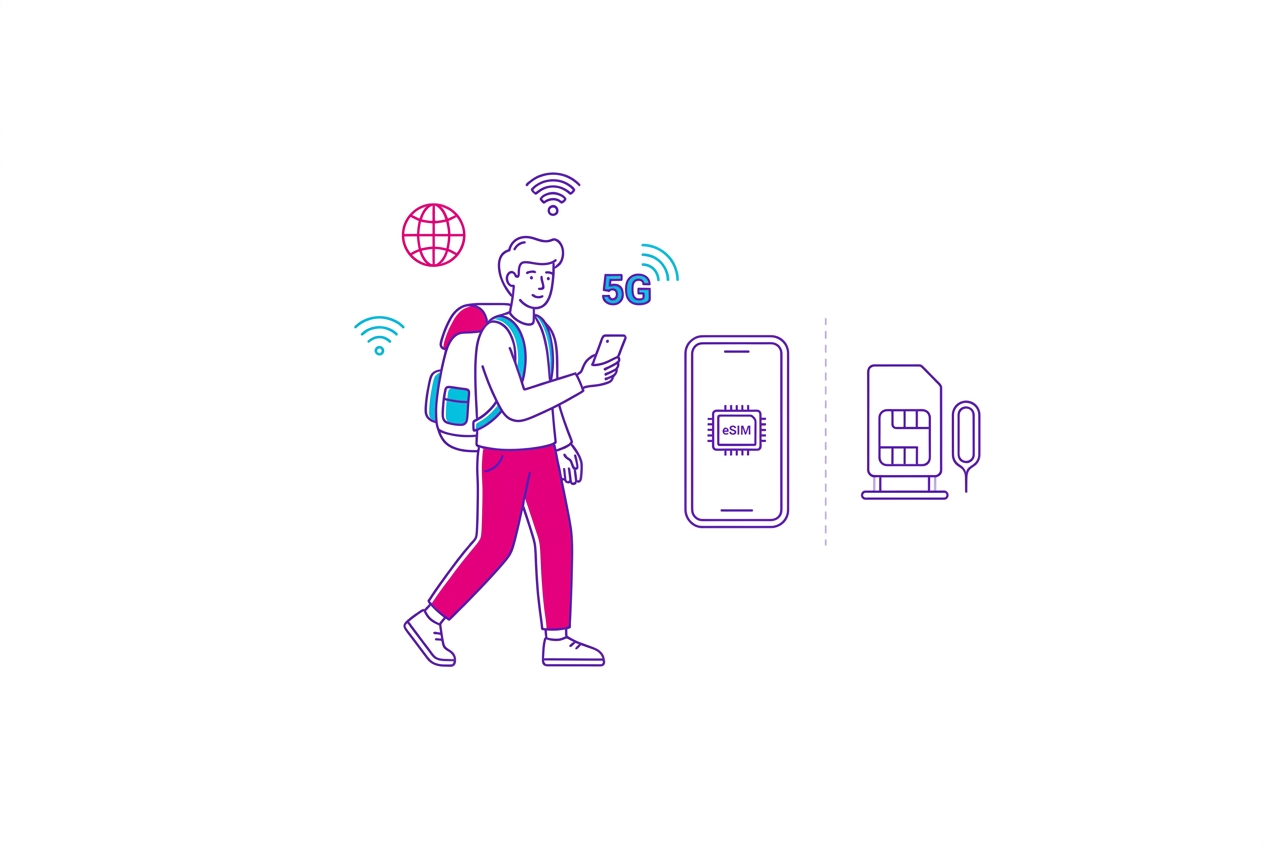
For most modern international travelers, eSIMs win on convenience, instant activation, and security, while physical SIM cards remain the best choice for budget travelers with older, carrier-locked devices or those visiting remote areas where local physical SIMs offer cheaper, cash-only rates.
Choosing how to stay connected abroad used to be simple: you landed, found a local kiosk, and swapped out a tiny piece of plastic. Today, digital eSIMs have completely changed the landscape. Understanding the practical trade-offs between these two technologies is essential for seamless global connectivity.
Summary
- eSIM Wins on Convenience: No physical swapping, zero risk of losing your home SIM, and instant activation before you even board your flight.
- Physical SIM Wins on Legacy Compatibility: Best for older, carrier-locked devices that do not support eSIM technology.
- Dual-SIM Power: Modern travelers can use both simultaneously—keeping their home number active for emergency texts while routing data through a cheap travel eSIM.
- The Reusability Factor: While most travel eSIMs are single-use, providers like HOLASIM offer lifetime eSIMs that you install once and top up forever.
What is an eSIM and How Does It Work?
An eSIM (embedded SIM) is a programmable microchip built directly into your smartphone's motherboard. Instead of inserting a physical plastic card to tell your phone which cellular network to connect to, you download a digital profile—typically by scanning a QR code or using a dedicated app.
According to our proprietary eSIM Price Index (last updated 2026-06-26), the entry barrier for travel eSIMs has plummeted. For example, global providers like HOLASIM now offer starter plans from as low as USD 1.70, making digital connectivity cheaper than ever.
Head-to-Head Comparison: eSIM vs. Physical SIM
| Feature | eSIM (Digital SIM) | Physical SIM Card |
|---|---|---|
| Installation | Instant digital download via QR code or app | Physical insertion using a tray tool |
| Convenience | Buy and activate anywhere in the world | Must purchase at airport, store, or wait for shipping |
| Security | High (cannot be stolen or lost if phone is stolen) | Low (can be physically removed and cloned) |
| Device Compatibility | Flagship phones from 2018+ (must be unlocked) | Works in virtually any mobile phone ever made |
| Multi-Network | Store multiple profiles and switch digitally | Limited to one physical card per slot |
| Pricing | Starts from ~USD 1.70 (e.g., HOLASIM) | Varies; local cash rates can sometimes be cheaper |
The Pros and Cons of Travel eSIMs
Reasons to Buy an eSIM
- No Physical Swapping: You do not have to carry a paperclip, open your SIM tray on a cramped airplane, or risk losing your primary home SIM card.
- Immediate Connectivity: You can purchase and install your plan at home, turn it on the second your plane touches down, and instantly book a rideshare.
- Keep Your Home Number Active: By using Dual SIM mode, you can receive two-factor authentication (2FA) SMS codes on your home physical SIM while using the eSIM for cheap data.
- Lifetime Reusability: Premium providers like HOLASIM feature a unique "install once, keep for life" model. The eSIM never expires, allowing you to simply purchase a top-up for your next destination (covering 200+ countries) without scanning a new QR code.
Reasons to Avoid an eSIM
- Device Restrictions: If your phone was manufactured before 2018 or is locked to a specific carrier contract, it will not support eSIMs.
- No Physical Transfer: You cannot easily pop an eSIM out of a dead phone and place it into a travel companion's device.
The Pros and Cons of Physical Travel SIMs
Reasons to Buy a Physical SIM
- Universal Compatibility: Every mobile phone with a SIM slot can use one, regardless of age or budget tier.
- Anonymity and Cash Purchases: In many developing nations, you can buy a physical SIM with cash at a street kiosk without registering your digital identity.
- Easy Device Swapping: If your phone breaks or runs out of battery, you can instantly move your physical SIM to another phone.
Reasons to Avoid a Physical SIM
- The Airport Markup: Buying a physical SIM at an international airport terminal often comes with heavy tourist markups and long queues.
- Risk of Loss: Storing your tiny home SIM card in a wallet or passport holder for weeks at a time is a recipe for losing it.
- Physical Wear and Damage: Gold contacts can scratch or collect dust, leading to sudden loss of connectivity.
Cost Analysis: Real Travel Data
Is an eSIM more expensive than a physical SIM? Not anymore. According to our eSIM Price Index (updated June 2026), digital plans are highly competitive with local physical options, especially when accounting for convenience.
Let’s look at the indicative pricing for 5GB of data across popular global destinations:
- United States: HOLASIM offers 5GB for 15 days at USD 13.50 (USD 2.70/GB), while Airalo's 30-day equivalent is USD 15.88.
- Europe: A 5GB / 15-day HOLASIM plan costs USD 13.50, compared to USD 19.49 for a 30-day Saily plan.
- Japan: HOLASIM provides 5GB for 30 days at USD 10.00 (an incredibly low USD 2.00/GB), while Airalo costs USD 11.00.
- Thailand: Saily leads budget pricing at USD 7.99 for 5GB, with HOLASIM close behind at USD 15.00 for high-speed routing.
For heavy users, unlimited data plans are also widely available. Holafly offers unlimited data in the United States for 15 days at USD 50.50, while global operators like HOLASIM offer tailored unlimited packages with premium human support to keep you connected without caps.
The Verdict: Which Should You Choose?
Choose an eSIM if: You have an unlocked, modern smartphone, value your time, want to avoid airport lines, and want the security of keeping your home number active for banking codes. If you travel frequently, choosing a lifetime global eSIM like HOLASIM simplifies the process even further by eliminating the need to download new profiles for every trip.
Choose a physical SIM if: Your phone is carrier-locked, you are using an older device, or you are traveling to an off-the-grid destination where digital eSIM infrastructure is not yet supported by local networks.
How we rank: eSIM Global ranks and reviews providers based on independent cost-per-gigabyte analysis, network partner reliability, and real-world testing. Our eSIM Price Index is updated monthly to ensure accurate pricing.