AST SpaceMobile Launches Its Biggest Satellites Yet in 2026: What It Means for Travelers
AST SpaceMobile put three Block 2 BlueBird satellites into orbit on August 5, 2026 — the largest commercial phased arrays ever flown. Here is what direct-to-phone satellite service will and will not do for you abroad.
What happened
On August 5, 2026, at 3:42 AM EDT, a SpaceX Falcon 9 lifted off from Cape Canaveral carrying three of the strangest-looking spacecraft ever built: AST SpaceMobile's BlueBird 11, 12 and 13.
These are the first of the company's next-generation Block 2 satellites, and their headline number is hard to ignore. Each one unfolds a phased-array antenna of nearly 2,400 square feet — roughly three and a half times the 693 square feet of AST's first-generation BlueBirds, and the largest commercial phased arrays ever deployed in low Earth orbit.
The reason they fit on a single rocket at all is a stackable composite carbon framework that lets multiple multi-ton payloads nest compactly inside SpaceX's standard 5-meter fairing. Three satellites, one launch, no folding origami compromises on array size.
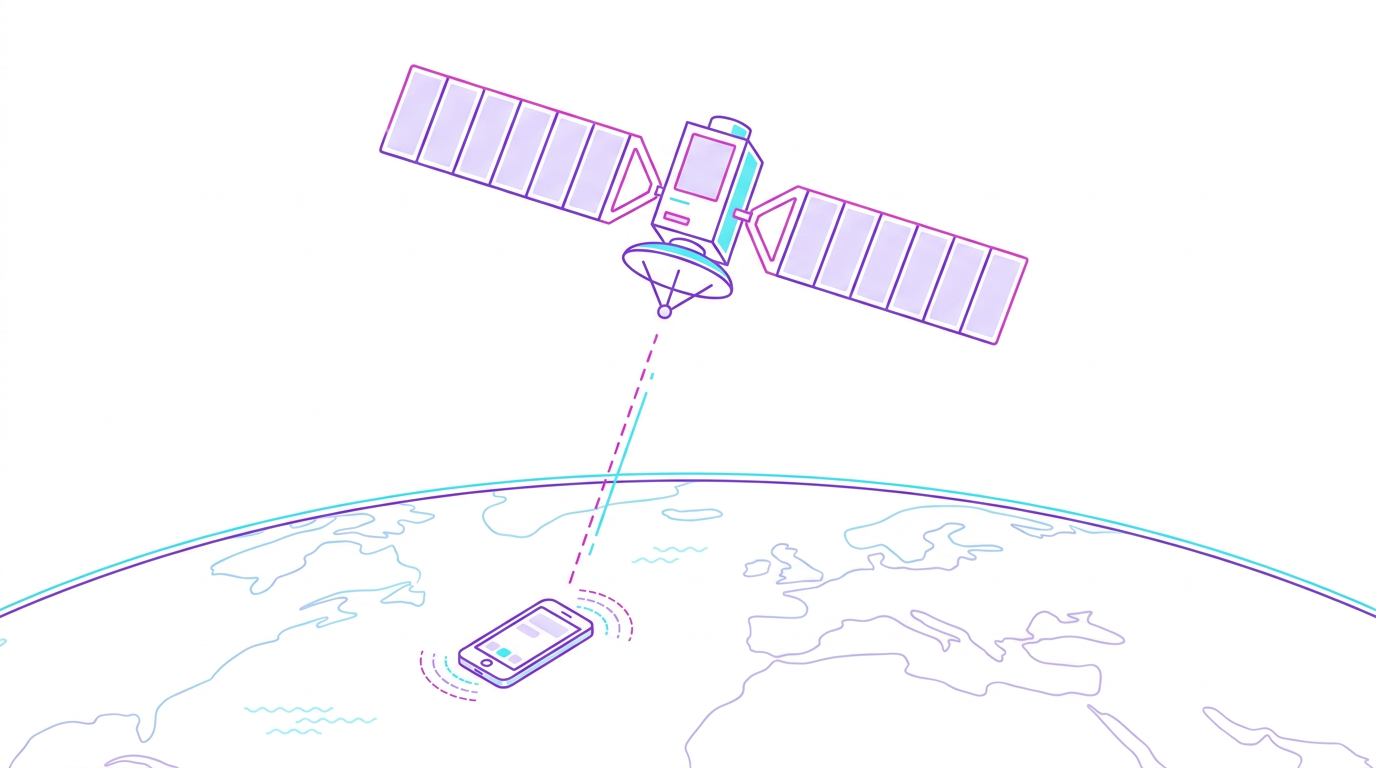
The point of all that surface area is bandwidth. AST is not building a network for satellite phones with chunky external antennas. It is building one that talks to standard, unmodified smartphones — the one already in your pocket — for voice, data and video, and increasingly for commercial and government applications on top.
Why this matters if you travel
For years, the honest answer to "will my phone work out there?" was no. Not on a hiking trail in Patagonia, not on a ferry in the Aegean, not on a two-lane road through the Australian outback. Coverage maps are drawn around population density, and travelers routinely leave that density behind.
Direct-to-device satellite service is the first credible answer to those dead zones, and 2026 is the year it stopped being a demo:
- Starlink Direct to Cell now has more than 650 satellites in orbit, is commercially live in around 22 countries, supports roughly 60 phone models, and sells as a low-cost monthly add-on — about $10 in the US, where T-Mobile brands it T-Satellite.
- SpaceX also signed its largest direct-to-cell deal yet with VEON, opening access to more than 150 million potential customers across Kazakhstan, Ukraine, Pakistan, Bangladesh and Uzbekistan. VEON's Kyivstar in Ukraine launched first and had already registered over 3 million users and delivered more than 1.2 million satellite SMS by mid-January 2026.
- AST SpaceMobile is coming at it from the operator side, with partnerships already in place with AT&T, Verizon and Orange, and beta direct-to-device service tied to this Block 2 launch.
Regulators are moving too. The FCC's August 2026 agenda is being watched closely for early signals on how direct-to-device services might use unlicensed spectrum — a decision that would shape how fast, and how cheaply, this scales.
The part the headlines skip
Here is the sober counterweight. Industry analysts spent mid-2026 warning that direct-to-cell usage is likely to underwhelm relative to the hype, and the reason is physics, not pessimism.
One satellite beam covers an enormous footprint, and everyone inside that footprint shares the same capacity. That works beautifully for a text message, a location ping or an emergency call. It does not work for streaming, video calls or uploading a week of photos. Early services are messaging-first for a reason, and even as data arrives, expect it to feel like a slow, precious resource rather than a replacement for the ground network.
So the realistic 2026 picture is a two-layer setup: terrestrial data for everything you actually do, satellite as the safety net when terrestrial disappears. Anyone selling you satellite as a substitute for a local data plan is overselling it.
What to do about it before your next trip
The practical takeaway is not "wait for satellites." It is to get the terrestrial layer right and let satellite cover the gaps.
- Check whether your phone and plan already include it. Satellite messaging is quietly bundled on a growing number of carriers and handsets. It may already be sitting in your settings, unused.
- Sort out data with a travel eSIM before you fly. Satellite will not save you from a $12-a-day roaming pass. A prepaid travel eSIM installed at home means you land connected, and providers like HOLASIM let you set it up before departure rather than hunting for airport Wi-Fi. If you have never done it, our step-by-step travel eSIM setup guide walks through it.
- Keep a second line active. Your home number staying reachable on satellite while a travel eSIM carries the data is the most robust combination available right now — and it is exactly what eSIM makes easy. For more on how satellite fits alongside roaming, see our breakdown of satellite 5G and NTN.
- Do not throw away offline maps. The best connectivity plan still has a paper-thin backup.
Block 2 BlueBirds are a genuine engineering milestone, and within a few years "no signal" may sound as dated as "no roaming agreement." Until then, the traveler who wins is the one who lands with data already working.