The 2026 World Cup Broke Mobile Data Records: 500 TB on Verizon, Nearly 1 PB on AT&T
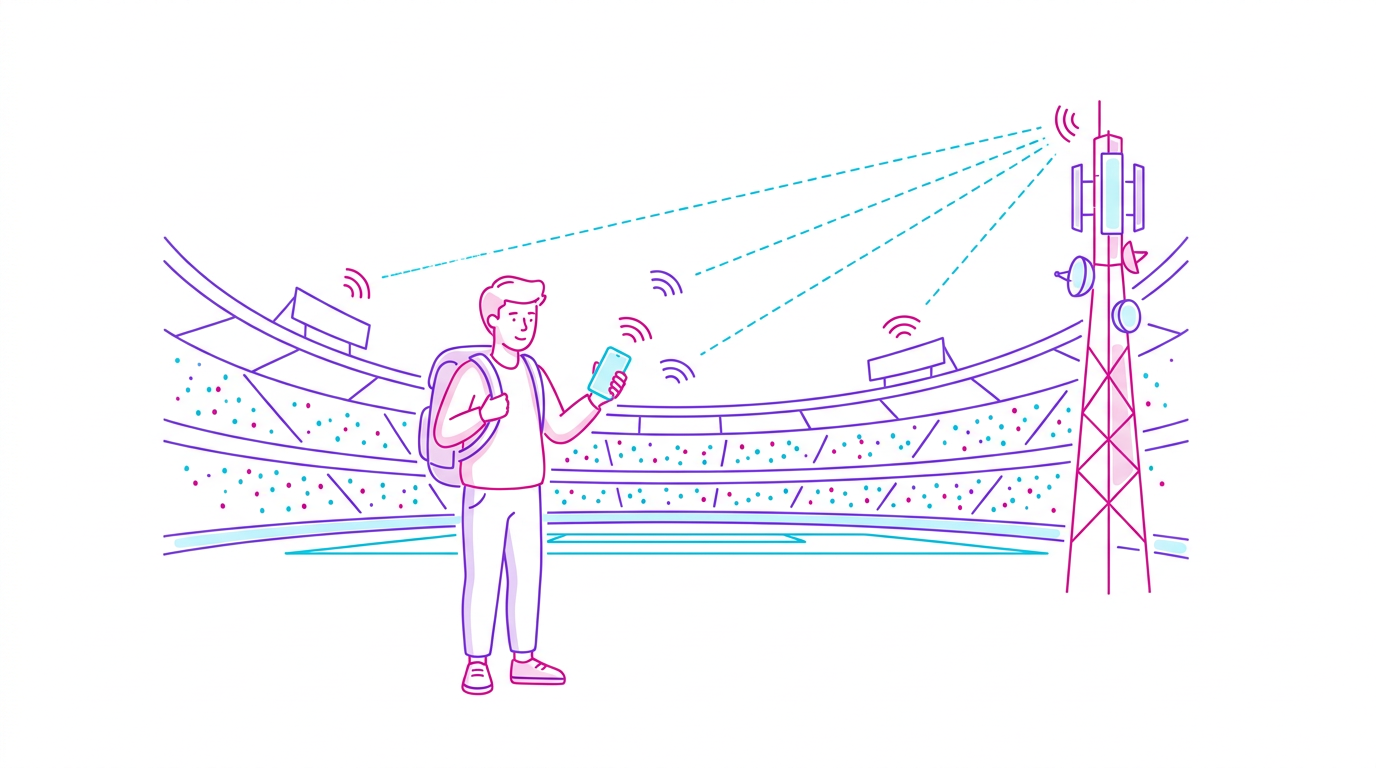
The 2026 World Cup was the most heavily instrumented mobile event in history, and the operators have now published what their networks actually carried. The numbers are worth reading if you travel — not because you care about carrier bragging rights, but because they explain, precisely, why your phone stops working in crowds.
The headline figures
Verizon moved close to 500 TB of data across World Cup stadiums over the course of the tournament. The single-match peak came in the final: 29.2 TB inside one stadium. To handle it, Verizon upgraded stadium network capacity by three to five times at every US venue and deployed nearly 140 small-cell and temporary-site projects beyond the stadiums themselves — transit hubs, FIFA Fan Festivals and watch parties.
AT&T reported close to one petabyte of traffic across US host cities, with over 99% voice and data reliability, after engineering its network for two to three times normal traffic volumes.
Independent measurement told the same story from a different angle: roughly 770 TB of mobile data was recorded after just the first six days and 20 matches. Across the whole tournament, about 6.5 million fans passed through venues.
The finding that should change how you think about mobile data
The most useful detail isn't the totals. It's the direction of traffic.
Verizon found that upload traffic surged nearly 70% at half-time. Not download. Upload.
This inverts the assumption most mobile networks were designed around. Cellular capacity has historically been allocated asymmetrically — lots of downlink, much less uplink — because the model was people consuming video. In a stadium, everyone is producing it: uploading clips, going live, sending video messages. Peak load isn't during the goal, it's in the pause afterwards when 60,000 people simultaneously post about it.
You have experienced the traveler version of this. Your phone shows full bars at a festival, a New Year's countdown, a packed airport gate or a cathedral queue, and nothing sends. Signal strength was never the problem. The uplink was saturated.
What travelers can actually take from this
Full bars means nothing about capacity. The signal indicator measures how well you hear the tower, not whether the tower has room for you. In dense crowds, a weaker signal on an uncongested band frequently outperforms a strong signal on a saturated one.
Which network you attach to matters more than which brand sold you the data. At a mega-event, one operator may have spent heavily on temporary capacity while another didn't. A travel eSIM that can reach multiple host networks in a country has a structural advantage over one locked to a single operator — this is a specification worth checking before you buy, and it is the sort of thing that separates providers more than headline price does. Our Ookla-based look at travel eSIM performance found real-world speed differences of up to 10x between providers on the same route.
Uploads are the thing to plan around. If you need to send footage from a crowded event, do it before or after the crowd peak, or accept that it will queue. Text and voice notes get through when video won't.
Roaming infrastructure strains too. Mega-events don't just load the radio network. Millions of visiting fans generate enormous inbound roaming traffic, which pressures international interconnections, roaming platforms and authentication systems — the invisible plumbing that decides whether your home SIM can even register on a foreign network. At the 2022 final, an estimated 32,000 fans in the stadium were roaming subscribers. In 2026, across three host countries, that figure was orders of magnitude larger.
That last point is the quiet argument for a local-network eSIM rather than home-carrier roaming during any major event. Roaming registration depends on a signalling chain between two operators that can queue or fail under load. An eSIM profile provisioned on a domestic network in the country you're standing in skips most of that chain. Providers including HOLASIM sell exactly this: a profile you install before departure that attaches as a local subscriber on arrival.
The bigger picture
GSMA Intelligence's post-tournament analysis framed 2026 as the event where 5G and eSIM together redefined the fan experience — ticketing, wayfinding, translation, payments and streaming all assumed a working connection as a baseline rather than a bonus.
That's a reasonable description of travel in general now. The infrastructure got dramatically better and simultaneously got dramatically more load. What the World Cup data shows is that the remaining failures aren't about coverage maps. They're about contention, uplink and which network your device happens to be sitting on when 60,000 other people want the same thing.