Travel eSIMs Hit 3.4% of Global Roaming in 2026 - But Speeds Can Differ by 10x, Ookla Finds
New Ookla data for Q2 2026 shows travel eSIMs taking a bigger share of international roaming than ever - and latency gaps of up to 10x between brands on the same street.
Travel eSIMs are no longer a niche product. According to new second-quarter 2026 data from testing and analytics firm Ookla, branded travel eSIMs accounted for 3.4% of all measured international roaming activity worldwide, up from 2.7% a year earlier. That is a significant jump in a category most travelers had never heard of five years ago.
The growth rate is even more telling. Ookla said measured activity from branded travel eSIMs grew at a "strong double-digit rate" in the twelve months to the end of June 2026, and that this "substantially outpaced" growth in overall international roaming, which came in at 12%. Roaming as a whole is expanding - and travel eSIMs are taking a bigger slice of it every quarter.
More than 50 brands, a handful of actual networks
Ookla counted more than 50 retail travel eSIM brands running on a small group of wholesale networks, naming Holafly, Airalo, CMLink and Saily among the largest. Airalo crossed a $1 billion valuation in July last year after a $220 million round led by CVC. Holafly, which Ookla describes as its closest rival, announced in September that it had passed $500 million in cumulative revenues.
Behind those consumer-facing apps sits a much shorter list. Ookla identified the main wholesale providers orchestrating roaming agreements globally as Hutchison (Austria and Hong Kong), China Mobile Hong Kong, KPN, Orange, Singtel, Telna, Webbing, Transatel, Proximus, BICS, Plus in Poland and Sky in the UK.
Those relationships shift constantly. In Q2 2026 alone, Airalo increased its use of KPN and brought Telna onboard, while Holafly consolidated around Hutchison Austria. Both cut back sharply on Orange France. If the same eSIM app felt noticeably different on your last trip than the one before, this is often the reason: the interface stayed identical, the plumbing underneath changed.
Why identical signal bars can mean wildly different speed
The finding that matters most to travelers is about latency, not download speed.
"Two tourists standing on the same street, connected to the same local network, can experience response times that differ by a factor of ten because of decisions made in wholesale agreements they are not aware of," Ookla said.
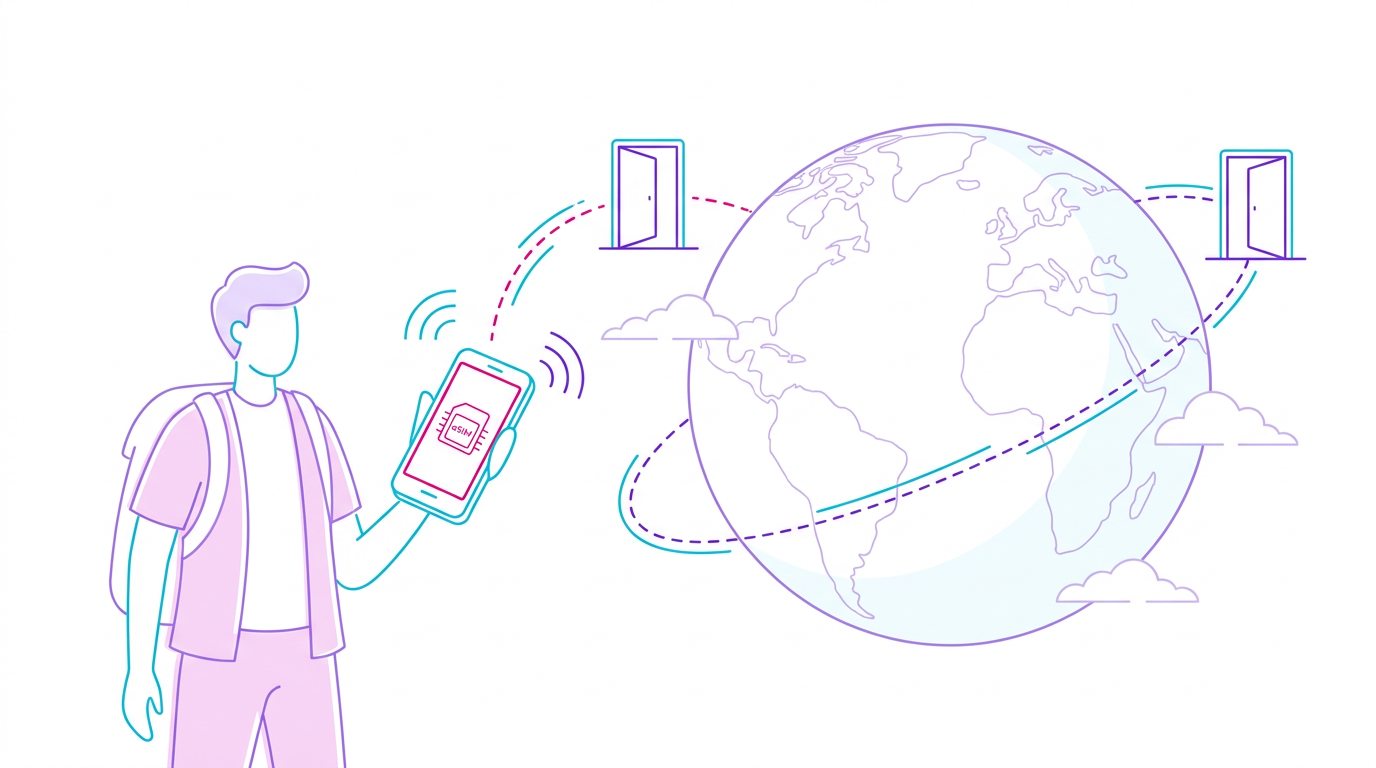
The cause is where your data exits to the internet. Some providers route everything through a single global hub. Others run a distributed core with regional exit points. True local breakout - where your traffic leaves for the internet inside the country you are actually standing in - is rare, but Ookla found it delivers the lowest latency by a wide margin.
The example Ookla gives is stark. On KDDI's au network in Japan, median eSIM latency ranged from 54 milliseconds with local routing to 543 milliseconds when the same traffic was hauled through Madrid - with identical radio conditions in both cases. A tenfold difference, completely invisible in your signal bars.
Ookla's advice to consumers is blunt: "The best travel eSIM for a given trip is the one whose exit door is closest to the destination." Its message to the industry is that "distributed cores and regional exits visibly outperform single hubs on every responsiveness metric."
What travelers can actually do about it
You cannot read a wholesale routing contract before boarding, but you can use proxies for the same information.
- Test latency on arrival, not download speed. Run a speed test in your first hour and look at the ping or latency figure. Under roughly 80 ms usually means regional or local egress. Over 300 ms means your traffic is taking a long detour.
- Latency is what you actually feel. Video calls, voice notes, maps re-routing, rideshare apps and card payment confirmations all depend on round-trip time rather than raw megabits. A 500 Mbps plan with 500 ms latency will feel worse than a 20 Mbps plan at 50 ms.
- Prefer providers that tell you the visited network. Knowing which local operator you will attach to is at least a hint about how the traffic is routed.
- Buy regional rather than global when you can. Regional plans are more likely to sit on a regional core than on a single worldwide hub.
- Keep a second profile in reserve. eSIMs are software. If the first one routes badly, you can install a second and compare within minutes - a real advantage over a physical SIM you had to buy at the airport.
Providers such as HOLASIM, Airalo, Holafly and Saily all sell the same basic promise: mobile data abroad without a carrier roaming bill. What Ookla's data suggests is that routing quality, not price per gigabyte, is becoming the real differentiator between them.
If you are still weighing a travel eSIM against your carrier's roaming add-on, our breakdown of eSIM vs roaming in 2026 covers the cost side in detail. And if your next phone ships without a SIM tray at all, see what eSIM-only phones mean for travelers.