Japan Now Requires ID for Local SIM and eSIM Activation in 2026 — But Not for Travel eSIMs
Japan introduced mandatory identity verification for data-only SIM and eSIM activations in April 2026. Here is who it actually affects, and why travel eSIMs bought abroad sidestep the paperwork.
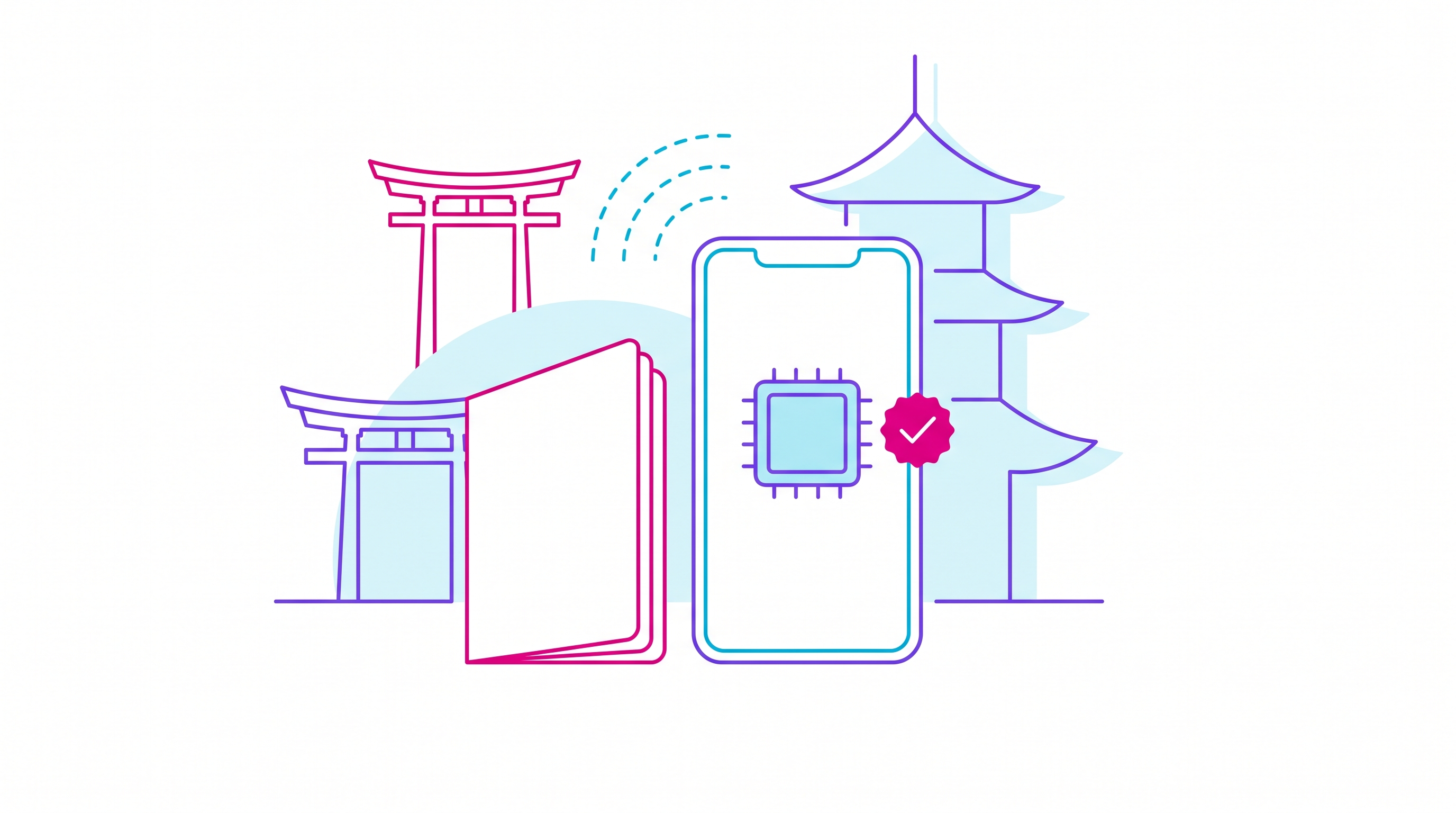
If you are flying to Japan this year and planning to grab a SIM at the airport, the paperwork changed.
In April 2026, Japan's Ministry of Internal Affairs and Communications introduced mandatory identity verification for all data-only SIM and eSIM activations in the country. Tourists and short-term visitors must present a valid passport at the point of activation. It is a small procedural change with a real effect on how you plan your first hour on the ground.
What actually changed
Japan already required identity checks for voice-enabled lines. The 2026 rule closes the gap by extending verification to data-only products, which is the category almost every tourist SIM falls into.
In practice that means:
- Buying a SIM or eSIM from a Japanese carrier — at an airport counter, an electronics store, or a convenience store — now requires you to show your passport and complete verification before the line is provisioned.
- Activation is no longer a five-minute transaction you can do half-asleep after a fourteen-hour flight. Expect a form, a document scan, and a queue.
The stated aim is to curb anonymous lines used in fraud and telecom-enabled crime, which is the same logic behind SIM registration laws in dozens of countries. Japan is not an outlier here — it is catching up.
The exception that matters
Here is the part most coverage buries: travel eSIMs purchased from an international provider before your trip are a different product.
When you buy a Japan data eSIM online from a provider based outside Japan, you are not activating a Japanese domestic line at a Japanese point of sale. You purchase online, receive a QR code or activation link by email, and install it yourself. No Japanese identity verification step is involved.
That distinction is why the practical advice for Japan in 2026 is unusually simple: buy before you fly. You skip the counter, the form, and the queue entirely, and you have working data the moment your plane's wheels touch the runway and you switch airplane mode off.
Japan is not alone
Thailand runs a comparable regime. Thai law requires registration for all SIM cards, and tourist SIMs bought locally involve a passport check and, in some cases, a photo capture at the point of sale. As in Japan, travel eSIMs bought from international providers before arrival avoid the local registration process.
Zoom out and the map gets busier. Dozens of destinations now require ID for local SIM purchase in some form. Some countries go further and restrict or block foreign eSIM profiles outright — we covered that separately in where travel eSIMs are blocked in 2026, which is a genuinely different problem: registration friction is an inconvenience, an outright block means the product will not work at all.
Japan and Thailand are firmly in the first camp. Nothing is blocked. There is just a desk between you and a local SIM that was not there before.
What this means for your trip
A few practical implications worth planning around:
Arrival timing gets tighter. If your itinerary depends on data immediately — a ride-hail booking, a rail pass QR code, a hotel address in a language you cannot read — a queue at the SIM counter is a bad dependency. Japanese airports are efficient, but immigration plus baggage plus a verification form is not a fast path.
Group travel multiplies the friction. Verification is per line, per person. A family of four buying local SIMs is four passport checks. Four travel eSIMs installed at home is four QR codes scanned over breakfast.
Passport availability. You will have your passport, obviously. But if you have already handed it over for a hotel check-in or a rail pass exchange, the sequencing gets annoying.
Refunds and mistakes. Buying under time pressure at a counter, in a second language, is how people end up on the wrong plan. Buying online at home means you can read the coverage details, the data allowance, and the validity window without a queue behind you.
The practical setup
For a Japan trip in 2026, the low-friction version looks like this:
- Buy a Japan or Asia-regional data eSIM before departure, while you are still on home Wi-Fi.
- Install the profile at home. Installation and activation are separate steps on most providers — you can install now and activate on arrival.
- Keep your home line for calls and SMS, with its data roaming switched off.
- Set the travel eSIM as your default for mobile data.
- Check your phone supports eSIM and is carrier-unlocked before any of the above.
Providers like HOLASIM sell regional data eSIMs covering Japan that install in a couple of minutes and switch on when you land — which is precisely the workflow the new Japanese rules reward.
If you have never installed one, our step-by-step travel eSIM guide covers the process on both iPhone and Android.
The rule change is not a reason to worry about connectivity in Japan. Coverage is excellent, 5G is widespread, and nothing about foreign eSIMs has been restricted. It is simply a reason to spend five minutes on this before you leave home rather than thirty at an airport counter after you arrive.