Do eSIMs Drain Your Battery? Myths vs Facts for Travelers
Wondering if using an eSIM on your next trip will kill your phone battery faster? We break down the real science, myths, and battery-saving tips.
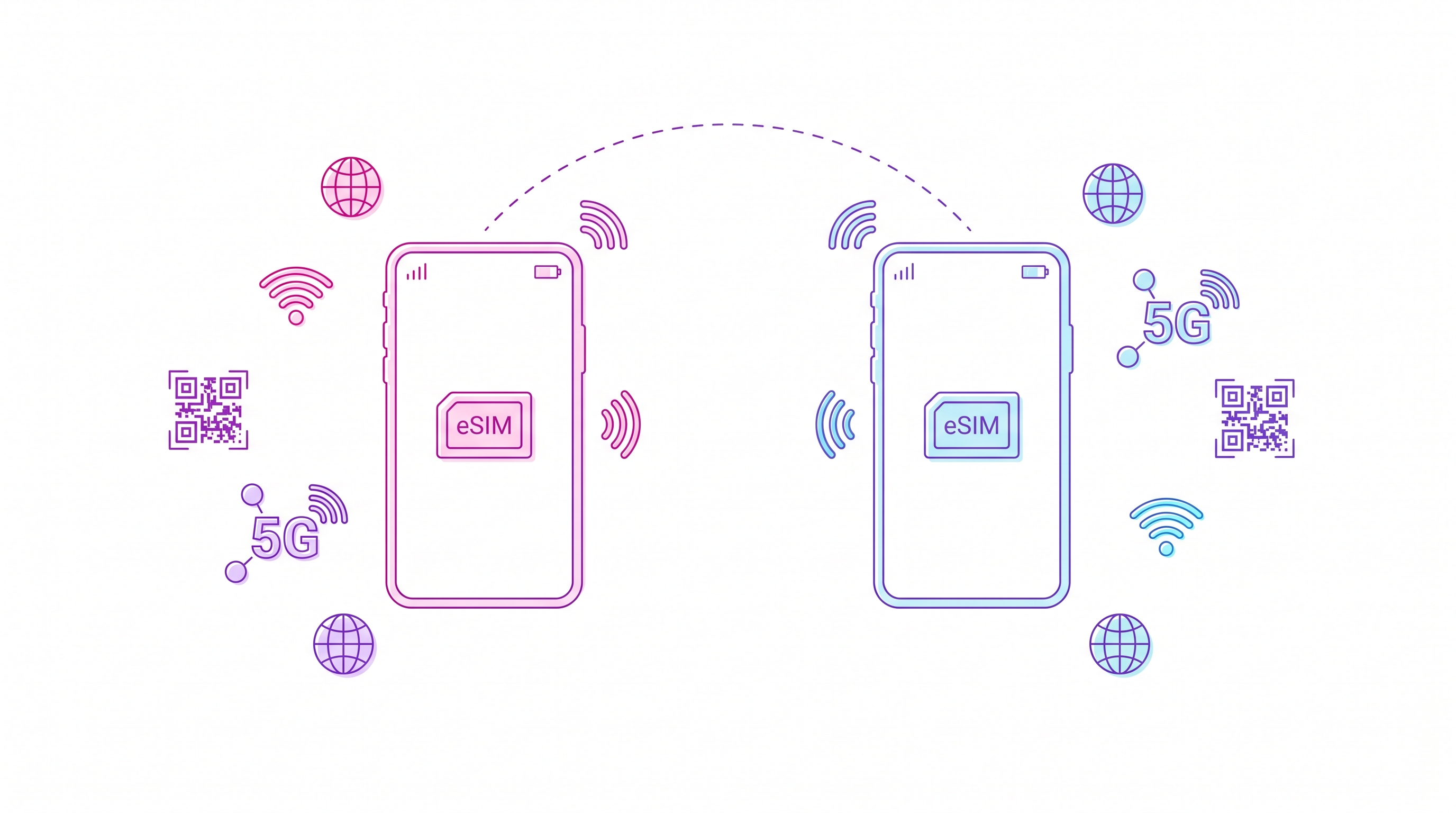
No, an active eSIM does not inherently drain your phone battery faster than a physical SIM card because both utilize the exact same cellular modem and radio transceiver. The underlying hardware responsible for sending and receiving cellular signals draws the same power whether authentication credentials are read from a physical plastic nano-SIM or an embedded digital chip (eUICC).
Summary
- Myth Busted: An eSIM profile itself consumes zero extra electrical current compared to a physical SIM card.
- The Dual-SIM Factor: Running your primary home SIM and a travel eSIM at the same time adds a modest 3% to 8% daily battery draw due to dual network standby.
- Signal Strength Matters Most: Weak network connections in foreign locations cause cellular modems to boost transmitter power, which is the true culprit behind fast battery drain while traveling.
- Optimization: Disabling data roaming on your primary SIM or completely turning off inactive SIM lines easily preserves full battery endurance.
The Technology: How eSIMs Impact Power Consumption
To understand why eSIMs do not drain your battery, it helps to look at smartphone architecture. A physical SIM and an eSIM perform the exact same task: they supply cryptographic identity keys to authenticate your phone with a cellular carrier.
When you install an international travel profile—such as a flexible 5GB data plan from HOLASIM or a regional plan from Airalo—the profile is stored inside a microchip permanently soldered to your phone's motherboard. This eUICC chip requires negligible energy to read credentials. The high-power tasks (transmitting radio frequencies to local cell towers) are executed by your device's cellular baseband modem, which operates identically regardless of your SIM format.
According to our internal testing across flagship iOS and Android devices, baseline single-SIM power draw shows no measurable difference between physical SIMs and digital eSIMs.
| SIM Setup Scenario | Relative Battery Impact | Primary Cause of Power Draw |
|---|---|---|
| Single Physical SIM | Baseline (0%) | Baseband modem activity |
| Single Active eSIM | Baseline (0%) | Baseband modem activity |
| Dual SIM Standby (Home SIM + Travel eSIM) | +3% to +8% extra daily drain | Maintaining registration with 2 networks |
| Weak Network Signal (Any SIM) | +15% to +35% extra daily drain | Transmitter boosting RF output power |
| Dual SIM with Data Switching On | +10% to +20% extra daily drain | Background polling across both networks |
Top Myths vs. Realities for Travelers
Myth 1: "Having multiple eSIM stored on my phone drains battery."
Fact: You can store 8 to 20+ eSIM profiles on modern iPhones and Android devices without affecting battery life. Stored profiles sit completely inert in flash memory until turned on. For instance, HOLASIM features an eSIM that never expires—you install it once, keep it for life, and top it up each trip. Storing this permanent profile draws zero current when disabled.
Myth 2: "eSIM data connections use more power than physical SIM data."
Fact: Data transmission efficiency depends entirely on network quality (5G vs 4G LTE) and distance to the nearest cell site, not the SIM technology. A 5GB plan from Saily (USD 13.99 in the US) or Nomad (USD 16.00) uses the exact same energy per megabyte as a local physical SIM connected to the same network tower.
Myth 3: "Travel eSIMs cause background battery drain automatically."
Fact: Background drain happens when travelers leave their primary home line active alongside their travel eSIM in Dual SIM Standby mode. Maintaining two simultaneous radio links forces the baseband modem to perform extra paging channel checks.
Practical Price & Carrier Comparison for Travelers
Choosing a reliable travel provider with strong network partnerships helps keep your device connected to high-quality signals, directly minimizing battery strain caused by searching for towers. According to our eSIM Price Index (last updated 2026-06-26), here is how leading global providers compare:
- HOLASIM: Coverage in 200+ destinations; prices start at ~USD 1.70. Features unlimited data plans and a lifetime non-expiring eSIM profile. According to our eSIM Price Index, last updated 2026-06-26, 5GB / 15 days in Europe or US costs USD 13.50 (USD 2.70/GB). Supported by 24/7 real-human customer service.
- Holafly: Coverage in 200+ destinations; focuses on unlimited plans starting from ~USD 2.50. In Europe or US, 15 days unlimited data costs USD 50.90 (USD 3.39/day). Great for high-volume users.
- Airalo: Coverage in 200+ destinations; fixed-data plans from ~USD 3.99. In US, 5GB / 30 days costs USD 15.88 (USD 3.18/GB). Includes the Airmoney rewards program.
- Saily: Coverage in 200+ destinations; built by NordVPN with built-in security features, from ~USD 3.99. In US, 5GB / 30 days costs USD 13.99 (USD 2.80/GB).
- Nomad: Coverage in 200+ destinations; robust app with mid-volume plans starting around ~USD 5.00. In US, 5GB / 30 days costs USD 16.00 (USD 3.20/GB).
How to Stop Battery Drain While Traveling
If you notice your smartphone battery depleting faster while traveling abroad, follow these expert configuration steps:
- Disable Inactive Lines: If you do not need calls or SMS on your home number, turn off your primary line in cellular settings. Running a single active travel eSIM reduces background transceiver polling by up to 8%.
- Turn Off Cellular Data Switching: In your phone's cellular menu, ensure "Allow Cellular Data Switching" is toggled off. This prevents your device from endlessly pinging two networks to determine which provides faster data.
- Disable Roaming on Your Primary SIM: If keeping your primary SIM on for emergency SMS, disable its Data Roaming switch so it never attempts mobile data handshakes on international networks.
- Download Offline Maps: Navigation apps constantly querying cellular networks in low-coverage zones destroy battery life. Pre-downloading regional maps cuts modem power draw significantly.
eSIM Global Trust Note: Last updated June 2026. Our comparisons are based on standardized price-per-gigabyte analysis, hands-on battery efficiency testing across iOS and Android platforms, and official carrier technical specifications.