Apple's C2 Modem Arrives With the iPhone 18 Pro - and Your 5G Abroad May Depend on Where You Buy It
Apple is expected to debut its own C2 cellular modem in the iPhone 18 Pro today. Reports point to a modem split by region, a sub-6 GHz focus and 5G satellite support - here is what each of those means once you leave the country.
Apple's autumn keynote is scheduled for today, September 9, 2026, at 10:00 a.m. Pacific. Invitations went out on August 26 under the tagline "Surprise and shine". Ahead of the event, the reported line-up is the iPhone 18 Pro and iPhone 18 Pro Max, Apple's first foldable iPhone, an Apple Watch Series 12 with a ceramic case option, an Apple Watch Ultra 4 and a new generation of AirPods.
If you travel, the interesting upgrade is not the camera. Three changes have been reported for the Pro models: a variable-aperture main camera, a smaller Dynamic Island, and Apple's own C2 cellular modem. The modem is the component that decides how your phone behaves in the twenty minutes after you land in another country.
Everything below is based on supply-chain reporting and pre-event coverage. Apple has confirmed the event, not the specifications.
The modem split nobody puts on the box
Through 2026, reports from MacRumors and AndroidHeadlines have converged on the same claim: iPhone 18 Pro units sold in the United States would keep a Qualcomm modem, while international units get Apple's C2. The reason given is mmWave - the very high frequency slice of 5G - which Apple's in-house design reportedly does not yet handle with the maturity it wants. C2 development concentrated on sub-6 GHz instead.
That sounds like international buyers get the lesser chip. Abroad, it is close to irrelevant. mmWave is a short-range, line-of-sight technology deployed at meaningful scale in a handful of countries, mostly inside stadiums, airports and dense downtown blocks. International roaming and travel eSIMs run on sub-6 bands - low-band for coverage, mid-band for capacity. A modem tuned for sub-6, with better weak-signal reception and lower power draw, is a better traveler's modem than one that wins peak-speed benchmarks on three city blocks in Manhattan.
There is a real consequence, though. If two hardware variants ship, "will my phone work in Country X" stops being purely a question about your plan and becomes a question about your model number. Before a long trip on a brand-new phone, check the band list for your exact model, not for the product family.
C2 brings 5G satellite into the modem itself
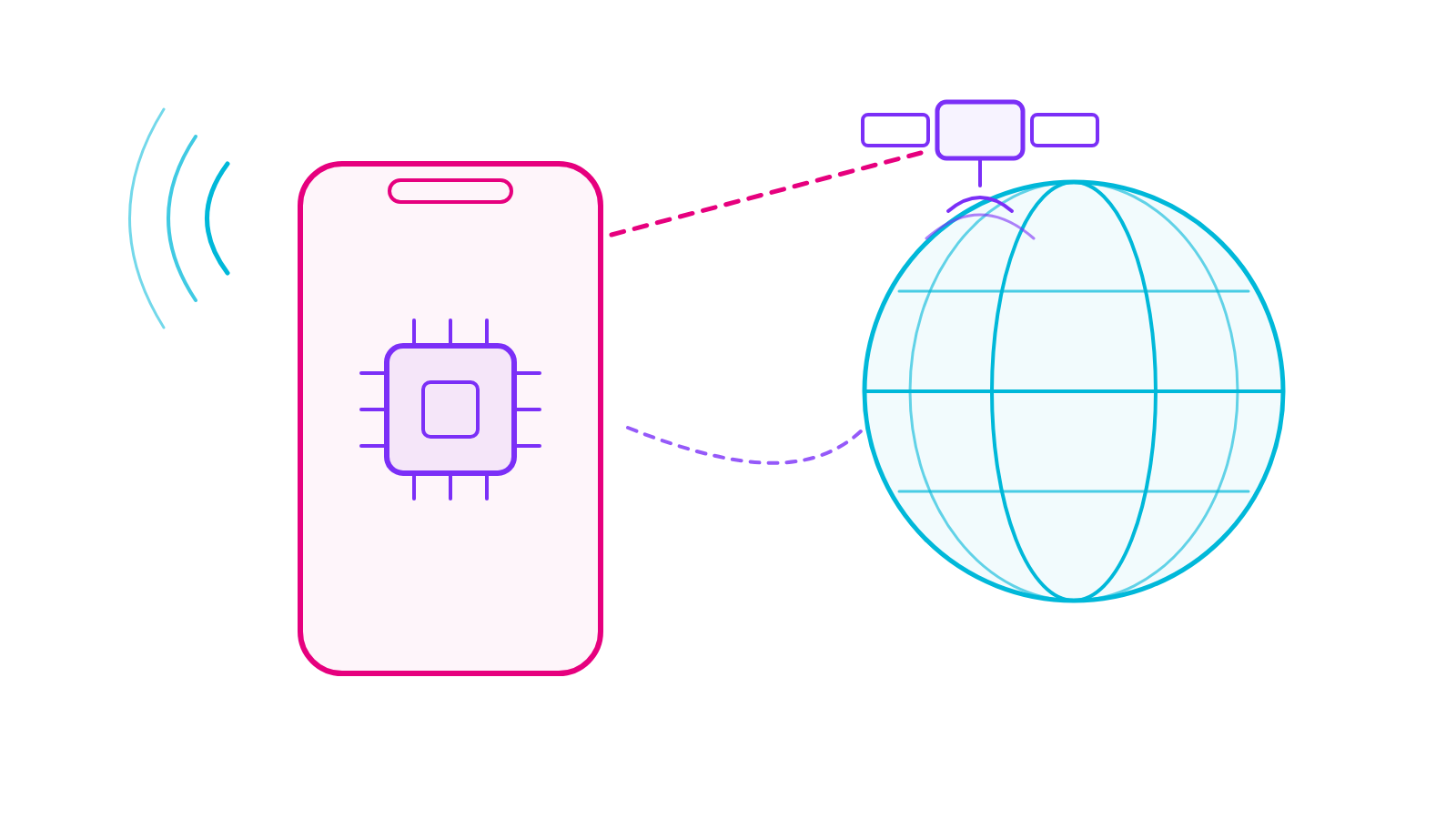
The C2 is also reported to support NR-NTN - 5G New Radio over Non-Terrestrial Networks. In plain terms: talking to a satellite using the ordinary 5G standard rather than a separate bolt-on system.
Where direct-to-device actually stands in 2026: Starlink's direct-to-cell constellation has passed 650 satellites, covering 22 countries with around 60 compatible phone models, and T-Mobile sells access as T-Satellite, a $10/month add-on that now works while roaming in Canada and New Zealand. The capability tier today is messaging and emergency use. The industry's own roadmap puts "voice and data indistinguishable from cellular" closer to late 2027. We covered the mechanics in Satellite 5G Is Here.
Read it as a safety net for dead zones, not as your data plan.
And then there is the SIM tray
US iPhones have shipped without a SIM tray since the iPhone 14. Reports say Europe is next with the iPhone 18 family, which we looked at in Apple Goes eSIM-Only in Europe.
Put the three pieces together and a pattern appears. eSIM-only hardware, a modem built for the sub-6 bands that roaming actually uses, and a phone that can hold several profiles at once. The old habit - land, find a kiosk, queue for a local SIM - stops making sense, because the decision has moved to before you board. Providers such as Airalo, Holafly, Saily, Nomad and HOLASIM all sell profiles you install at home and activate on arrival, and the newer the phone, the less friction there is in switching between them.
Practical checklist for a new phone abroad
- Install the travel eSIM before you fly, on Wi-Fi you trust. Activation on landing is a toggle; installation may need a QR code and a working connection.
- Keep your home line as the second profile, data off, so calls and two-factor SMS still arrive. Our eSIM vs roaming breakdown has the cost side.
- Do not chase peak speeds. For maps, messaging and boarding passes, weak-signal reliability and battery life beat headline throughput every time.
- Do not count on satellite for anything beyond a text from a dead zone this year.
- Check the bands for your exact model if you are buying a phone in one region to use in another.
The keynote will tell us what Apple actually shipped. The travel-relevant question is narrower than the launch coverage will suggest: not how fast the modem goes, but how well it holds a weak foreign network - and whether the plan running on it was bought before takeoff or in a panic at baggage claim.