EU Roaming in 2026: Free Roaming Extended to 2032, Ukraine and Moldova Now Included
The EU Roam Like at Home rules now run to 2032, cover Ukraine and Moldova since January 2026, and come with a lower wholesale data cap. Here is who actually benefits, and who still pays.
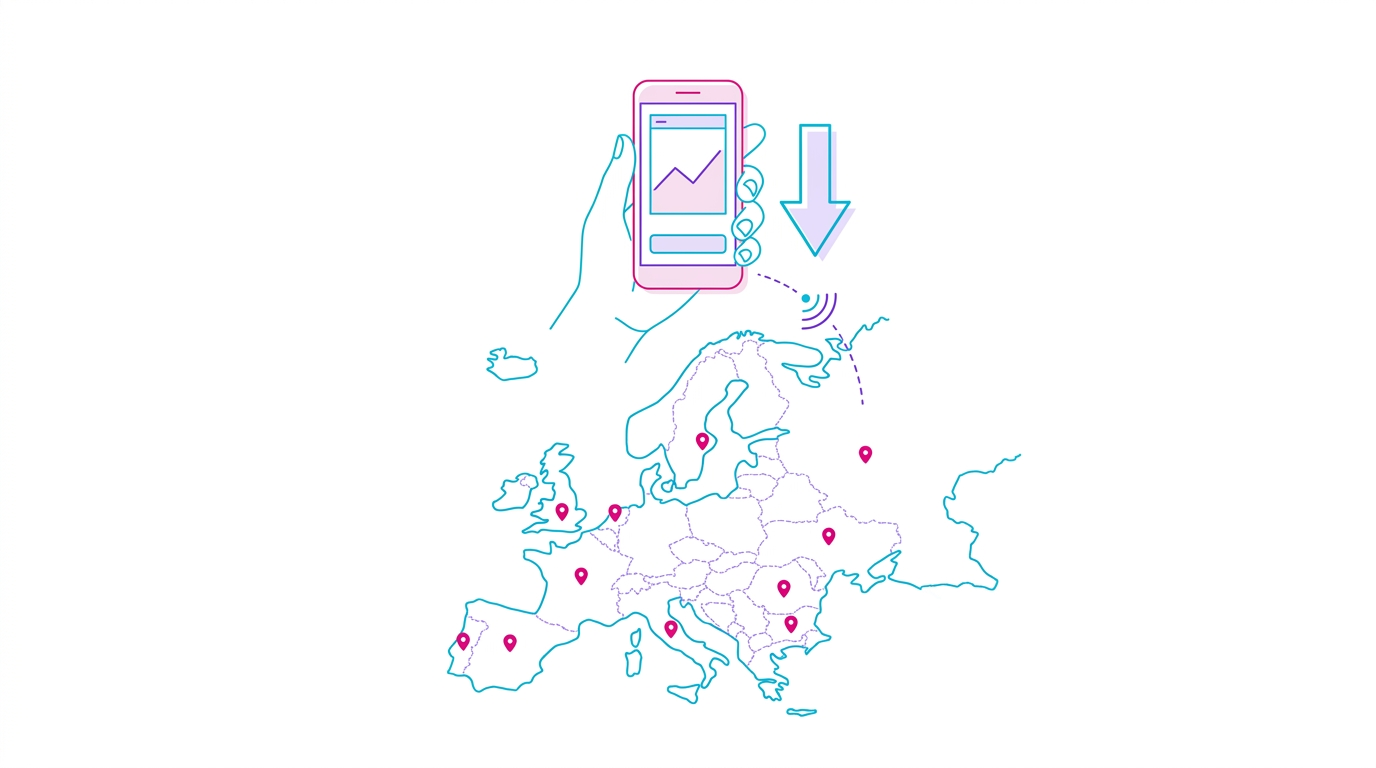
Europe quietly made its roaming rules permanent-ish. The EU Roaming Regulation, the law behind Roam Like at Home, has been extended by the European Parliament and the Council until 2032, and a set of changes took effect on 1 January 2026 that widen its geography and push wholesale prices down again.
If you carry an EU SIM, this is good news. If you do not, the headline is misleading in a way that costs money.
What actually changed in January 2026
Three things.
Roam Like at Home now covers Ukraine and Moldova. As of 1 January 2026, the RLAH area is no longer just the 27 EU member states plus Iceland, Liechtenstein and Norway. Ukraine and Moldova were brought inside it, meaning an EU customer travelling to Kyiv or Chișinău uses their domestic allowance at domestic prices, the same way they would in Lisbon or Warsaw.
The wholesale data cap fell from €1.30 to €1.10 per gigabyte. This is the price ceiling one operator can charge another for carrying its customers' data abroad. Travelers never see it on a bill, but it is the number that determines how generous a domestic plan can afford to be when its subscribers leave the country. Every step down in that cap has historically translated into bigger roaming allowances a year or two later.
Out-of-bundle browsing got cheaper. The regulated pay-as-you-go rate for data used beyond your bundle dropped to roughly 0.134 cents per megabyte including VAT, down from about 0.154 cents.
And the whole framework now runs to 2032, which removes the cliff-edge uncertainty operators had been pricing in.
The part nobody puts in the headline
Roam Like at Home is a benefit attached to the SIM, not to the traveler. It applies to lines issued by operators inside the RLAH area. That produces a very uneven map:
- You live in the EU and travel inside it. You are covered. Your plan works abroad at home prices, subject to fair-use limits on data volume for long stays.
- You live in the UK. Brexit removed the UK from RLAH, and several UK networks reintroduced daily roaming fees for Europe. We broke those down operator by operator in /article/uk-eu-roaming-charges-2026-what-each-network-charges-per-day.
- You live in the US, Brazil, Argentina, Mexico or anywhere else outside the area. RLAH does nothing for you. Your carrier's international roaming rates apply in full, and those are typically the most expensive way to get data that exists.
- You are an EU resident leaving the RLAH area. The moment you land in Turkey, Morocco, the UK, the US or Japan, you are on standard international roaming and the caps stop protecting you.
That last case is where most of the pain still sits. The regulation solved intra-European travel. It did not solve travel.
Fair use has not gone away
Even inside the RLAH zone, allowances are not infinite. Operators are permitted to apply fair-use policies, and the two that bite are a data volume ceiling tied to what you pay domestically, and a "stable links" test that checks whether you actually live where your SIM says you do. Spend months abroad on a domestic plan and your operator can legally start charging surcharges. RLAH was written for travelers, not for people relocating on a cheap contract.
Where a travel eSIM still makes sense
The clearer the EU rules get, the sharper the gap becomes on either side of the border. A travel eSIM is the practical answer in three situations:
- You are visiting Europe from outside it. No RLAH, no protection, no reason to pay roaming rates. A regional Europe eSIM covering 30-plus countries costs a fraction of a single day of carrier roaming for most non-EU networks.
- You are an EU resident going beyond the zone. Same logic in reverse. Your domestic bundle stops helping you at the RLAH border.
- You are staying long enough to hit fair-use limits. A dedicated data profile sidesteps the volume ceiling entirely.
Providers such as HOLASIM, Airalo, Holafly, Saily and Nomad all sell regional Europe plans, and the spread between them is wide enough to be worth ten minutes of comparison. Watch the per-gigabyte figure rather than the headline plan price — several providers repriced their unlimited tiers upward in 2026, so last year's ranking is not this year's.
The direction of travel
The 2032 extension, the widening geography and the falling wholesale cap all point the same way: inside Europe, roaming as a line item is finished. Outside it, roaming remains an expensive default that most travelers never had to actively choose. If you want the arithmetic on that, our comparison at /article/esim-vs-roaming-in-2026-how-much-you-really-save runs the numbers.