A New $1 Billion Satellite-to-Phone Network Just Got Funded - But Travelers Will Wait Until 2029
Viasat and Space42 committed up to $1 billion to Equatys, a 2,800-satellite direct-to-device network. Service starts in 2029, and it will not replace your travel eSIM.
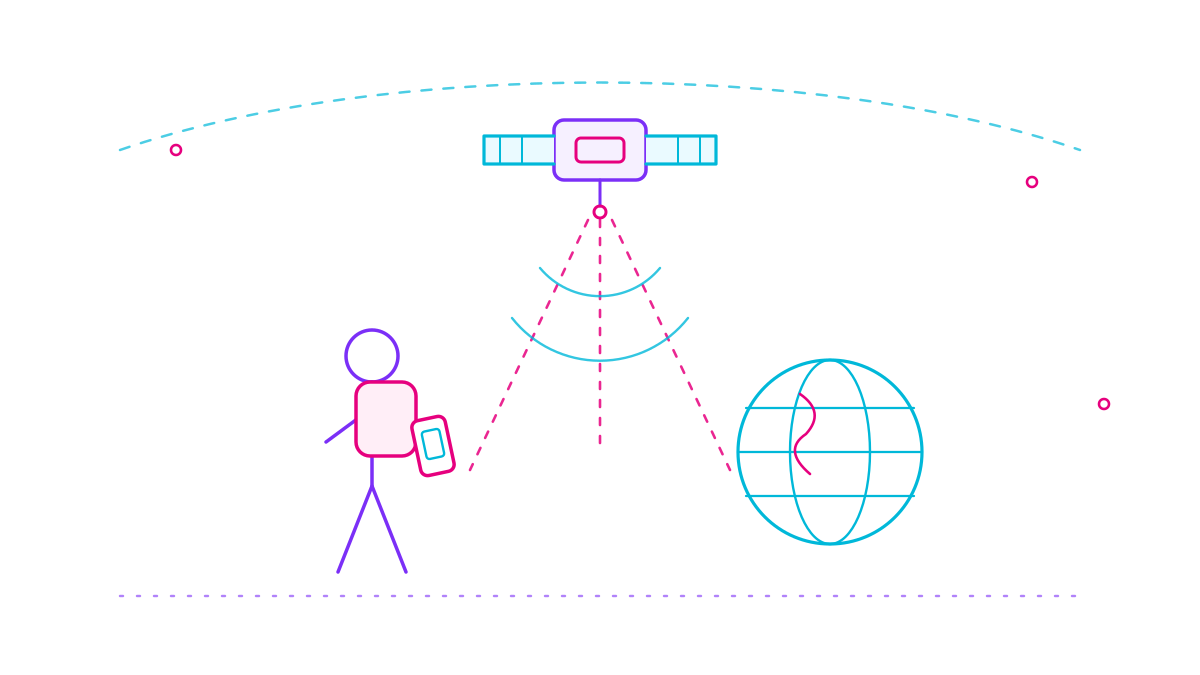
Another satellite-to-phone network just cleared its funding hurdle. On Monday, September 14, 2026, timed to World Space Business Week in Paris, Viasat and UAE-based Space42 signed a binding agreement to invest up to $1 billion in Equatys, the direct-to-device (D2D) joint venture first introduced under that name in late 2025.
The structure is worth reading closely, because it tells you how seriously the industry now takes putting a satellite link inside an ordinary phone.
What was actually announced
Space42 and Viasat are billed as the "initial" co-founders of the JV. Each commits $400 million up front. A further $200 million from Space42 is tied to a future equity funding round that remains open to third-party investors who have not been named yet.
The deal still requires regulatory approval. Analysts at New Street Research have flagged Rocket Lab - which recently struck a deal to acquire Iridium's technology, services and spectrum - as the most credible candidate to join, on the grounds that it is the only commercially proven Western player that can supply both constellation-scale manufacturing and low-cost launch, the two capabilities Equatys still lacks.
The numbers behind the network:
- 2,800 satellites in the initial constellation
- 60 orbital planes across three altitude layers, which the partners say allows densification without a redesign as demand grows
- Agreements with more than 400 mobile operators worldwide
- Access to more than 100 MHz of globally coordinated MSS (mobile satellite service) spectrum
- Space42 brings coordinated L-band rights across 160+ markets; Viasat holds coordinated L-band rights globally and S-band in Europe
Viasat will act as Equatys's "prime technology contractor." Both companies will be the initial anchor tenants.
The "tower company" model
The most interesting part is not the hardware, it is the business model. Equatys is designed as a neutral, independent platform - the satellite equivalent of a terrestrial tower company. Other spectrum licensees and satellite operators can use the constellation without being required to invest in it.
"The business model is open by design," the two companies said, describing a system built for high levels of spectrum aggregation, coordination and cooperation.
That matters because the D2D field is getting crowded fast. Equatys enters a sector already occupied by SpaceX, Globalstar and AST SpaceMobile. Amazon Leo, currently acquiring Globalstar, has filed a plan for a 5,105-satellite D2D constellation. AT&T, T-Mobile and Verizon have formed their own D2D joint venture that will tap multiple constellations. New Street Research estimates Viasat and Space42 could ultimately capture roughly 21% and 5% of the emerging D2D market respectively, on the assumption that market shares track MSS spectrum shares.
Why this matters to travelers - and why it does not, yet
Here is the part that gets lost in the funding headlines: Equatys services are expected to be available starting in 2029. A spokesperson confirmed that timeline to Light Reading. That is three years out, and it is the same pattern we covered in our piece on Starlink's European direct-to-cell rollout, where the headline arrives years before the service does.
Second, and more important for anyone planning a trip: as with D2D in general, Equatys is built to provide connectivity in areas that are out of reach of terrestrial wireless networks. That is the mountain pass, the desert road, the stretch of ocean. It is not the hotel in Lisbon, the cafe in Bangkok or the airport in Mexico City - places where terrestrial networks already work perfectly well and where the only real question is what you pay to use them.
The broader picture of how satellite phones are being absorbed into ordinary smartphones is something we broke down in our guide to the direct-to-device satellite market.
What to actually do about your connectivity in 2026
Satellite D2D is a safety net, not a data plan. Even as these constellations come online, the traffic they carry is designed for messaging, emergency contact and low-bandwidth signalling - not for uploading photos, running maps or joining a video call from a hotel room.
For the next several years, the practical answer for international travel remains the same:
- Buy a travel eSIM before you fly. Activation happens over Wi-Fi at home, so you land already connected instead of hunting for an airport counter.
- Match the plan to the trip, not to the fear. Most travelers overbuy data and underbuy days.
- Keep your home line on standby for SMS codes from banks and airlines, and route data through the travel eSIM.
- Check that your device supports eSIM and is carrier-unlocked before you buy anything.
Providers like HOLASIM sell exactly this kind of prepaid international eSIM, with coverage across the destinations most travelers actually visit, and activation that takes minutes rather than a trip to a store.
Equatys is a genuinely significant bet on the future of connectivity - $1 billion and 2,800 satellites is not a rounding error. But 2029 is 2029. For the trip you are booking this month, the eSIM in your phone is still the thing that decides whether you land connected.