eSIM-Only Phones Are Taking Over in 2026: What Travelers Need to Know
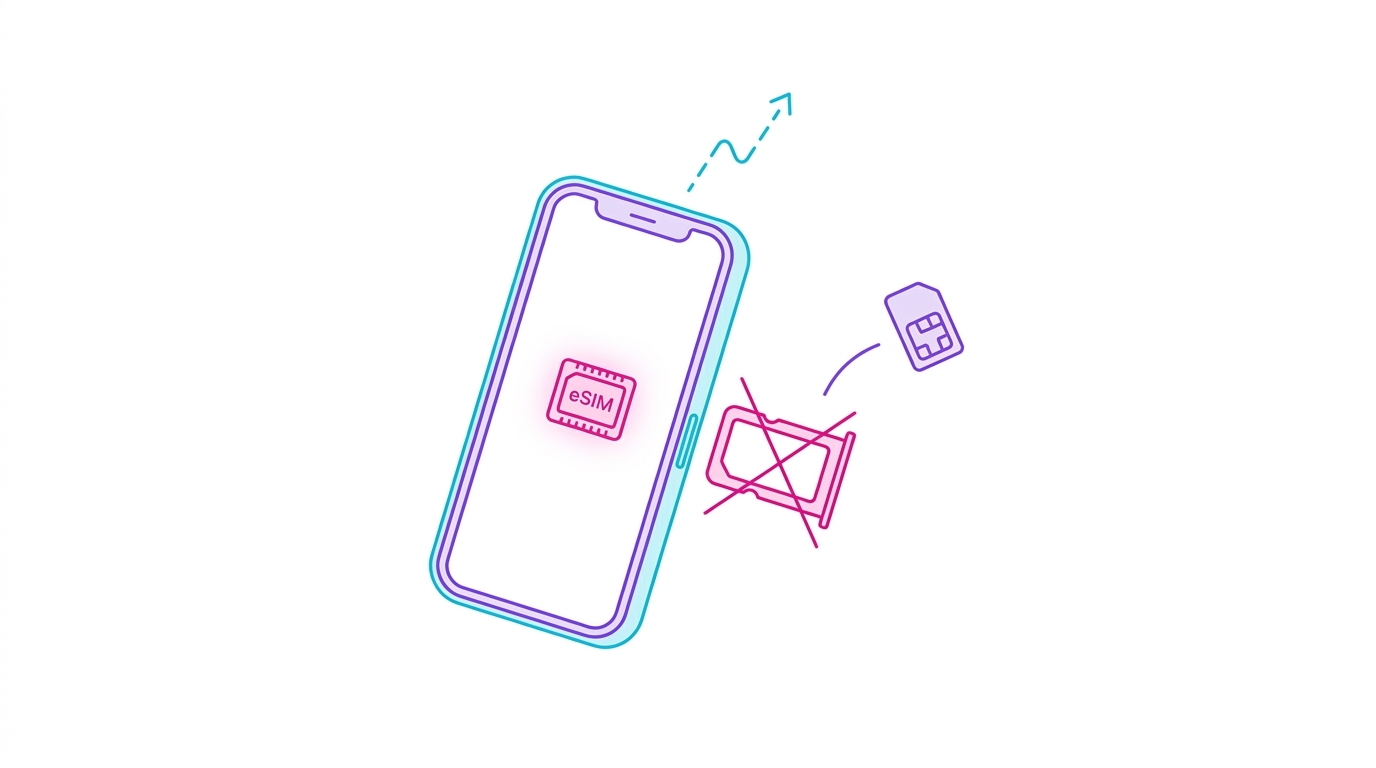
The SIM tray is disappearing, and 2026 is the year it became impossible to ignore. Apple shipped the iPhone 17 Air as its first globally eSIM-only iPhone — no physical SIM slot in any market, anywhere. Google's Pixel 10, 10 Pro and 10 Pro XL ship eSIM-only in the United States. Samsung's Galaxy S26 line is moving the same direction in selected markets. Apple's US lineup has already been tray-free since the iPhone 14, and that now extends through the iPhone 15, 16, 16e, 17 and the newer 17e.
For most people this changes nothing at home. For anyone who crosses a border, it changes the single habit that travelers have relied on for two decades: buying a local SIM card on arrival.
What actually changed
An eSIM is a chip soldered into the phone's board. Instead of swapping plastic, you download a carrier profile over the internet — usually by scanning a QR code or tapping through an app. The hardware has always been there on most flagships since 2018; what changed in 2026 is that manufacturers stopped shipping the physical fallback.
Two consequences follow directly:
- You can no longer buy a SIM at the airport kiosk. If your phone has no tray, that plastic card is useless to you. The kiosk may still sell you an eSIM QR code, but often at tourist-counter prices.
- You need internet before you have internet. An eSIM profile has to be downloaded. Doing that on arrival means depending on airport Wi-Fi, which is exactly the moment you least want a dependency.
The second point is the one that catches people out, and it has a simple fix: install the profile at home, on your own Wi-Fi, before you fly. Most travel eSIM plans only start counting data when the profile first connects to a network abroad, so installing early costs you nothing.
The compatibility question is now inverted
For years the question was "does my phone support eSIM?" In 2026 the more useful question is "does my phone still support a physical SIM?" Device lists have grown past 290 models with eSIM support, and the newest flagships from Apple, Google, Samsung and Motorola all qualify. Two things still trip people up:
- Carrier locks. An unlocked phone is required to install a third-party eSIM. Phones bought on installment plans from a carrier are frequently locked until paid off, and eSIM-only hardware makes that lock much more consequential — there is no tray to work around it.
- Regional variants. The same model number can be eSIM-only in the US and tray-equipped elsewhere. If you bought your iPhone 17 outside the US, you probably still have a tray. If you bought the 17 Air, you do not.
Dual SIM is the reason this works
The feature that makes eSIM-only phones genuinely better for travel is running two lines at once. You keep your home number active for SMS — bank codes, two-factor authentication, the airline texting you about a gate change — while routing all data through a travel eSIM. Your home carrier never sees a data session, so it never bills you for roaming.
Setting this up takes about thirty seconds in your phone's cellular settings: set the travel eSIM as the data line, leave your home line on for calls and texts, and turn data roaming off on the home line. That last toggle is the one that prevents a surprise bill.
What to do before your next trip
- Check now, not at the gate. Confirm whether your phone has a tray, and confirm it is carrier-unlocked.
- Install the eSIM profile at home. Over Wi-Fi, days before departure. Verify it appears in your cellular settings.
- Match the plan to the trip, not to the country. Regional plans covering a continent are usually cheaper per gigabyte than stacking single-country plans, and they survive an itinerary change.
- Check hotspot support. Not every provider allows tethering. If you travel with a laptop or a second traveler, this matters more than the headline price.
- Compare per-gigabyte, not per-plan. A $4 plan with 1GB is worse value than a $12 plan with 5GB.
Providers like HOLASIM, Airalo, Holafly, Saily and Nomad all sell profiles that install this way, and the market has become competitive enough that prices for regional plans have fallen sharply — some Europe-wide plans now start near $2. The devices have committed to eSIM; the pricing has followed.
If you want the numbers behind the savings, our breakdown of eSIM versus roaming costs runs through real carrier rates. And if you have never installed a profile before, the step-by-step setup guide covers the whole process in under five minutes.