Apple Goes eSIM-Only in Europe: iPhone 18 and the Foldable Drop the SIM Tray
Apple is extending its eSIM-only iPhone design to Europe and more regions in 2026, and its first foldable is expected to ship without a SIM tray anywhere in the world. Here is what it means if you travel.
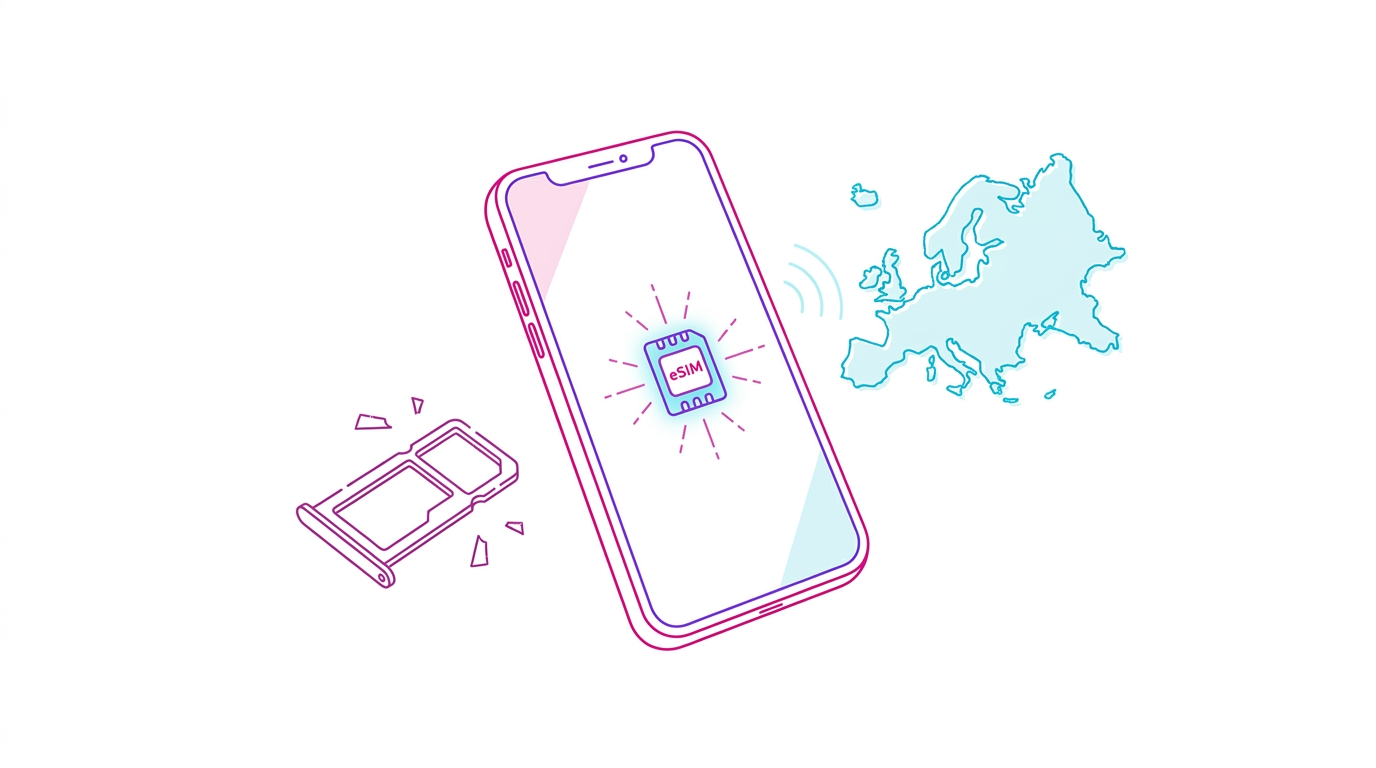
Apple removed the SIM tray from US iPhones back in 2022 and, for four years, most of the world treated it as an American quirk. In 2026 that ends. Reports around the iPhone 18 cycle point to Apple extending the eSIM-only design to Europe and several other regions, and Apple's first foldable iPhone is expected to launch without a SIM tray in every market it ships to.
For anyone who crosses borders regularly, this is the single most consequential change in phone hardware this year.
Where eSIM-only stands right now
The iPhone 17 family already ships eSIM-only in roughly a dozen countries, the United States among them, and the ultra-thin iPhone 17 Air went eSIM-only globally from day one — Apple simply could not fit a tray into that chassis. The iPhone 18 generation is expected to push the same configuration into European markets and beyond, with the foldable following as a worldwide eSIM-only device.
The engineering logic is not subtle. A SIM tray is a hole in the side of a waterproof device, plus a mechanical assembly and a chunk of internal volume. Delete it and you get room for battery, camera hardware, or thinner glass. Apple has been signalling for years that it wants a fully eSIM-only lineup globally, and the current trajectory puts that inside a three-to-five-year window.
Why travelers should care more than anyone else
The physical SIM was a travel tool. You landed, you found a kiosk, you swapped a tray, you kept your home SIM in your wallet and hoped you did not lose it. That workflow is being deleted.
What replaces it is better, but only if you plan for it:
- You cannot buy a local SIM at the airport. If your phone has no tray, the prepaid card sold at arrivals is useless to you. Some carriers in tourist markets can provision an eSIM on the spot with a QR code, but plenty still cannot.
- You have to be online to activate. eSIM profiles are downloaded over the internet. Downloading one after you land, on a phone with no connectivity, is a chicken-and-egg problem. The fix is simple: install before you fly, while you are on home Wi-Fi.
- Your home line does not have to go anywhere. This is the upside. Dual-eSIM iPhones keep your regular number active for calls, SMS and two-factor codes while a second profile carries your data abroad. No swapping, no lost trays, no missed verification codes.
The market moved first
Hardware is catching up to a shift that already happened commercially. Global eSIM connections are on track to hit roughly 1.5 billion in 2026, about 30% up year over year. Revenue from travel eSIM packages specifically climbed 85% in 2025, from around $989 million to $1.8 billion, and forecasts put the travel eSIM segment near $4 billion by the middle of the next decade.
Carriers noticed. AT&T launched its own travel eSIM product in 2026 for visitors to the US, Mexico and Canada, and Motorola began embedding a travel eSIM directly into its handsets. When the incumbents start selling the thing that was supposed to disrupt them, the argument is over.
What to do before your next trip
If you are buying an iPhone 18 in Europe this autumn, or any eSIM-only handset anywhere, treat connectivity as part of your packing list rather than something you sort out on arrival.
- Check the tray before you check the price. Confirm whether the exact model you are buying in your country has a physical slot. It varies by region, and it will vary less every year.
- Buy and install your travel eSIM at home. Providers such as HOLASIM, Airalo, Holafly, Saily and Nomad all let you install a profile days before departure and activate it when you land. Installation needs Wi-Fi; activation does not.
- Keep your home number on eSIM, not on a card. Ask your operator to convert your existing line to an eSIM before you upgrade. Migrating a physical SIM to a profile is far easier at home than in a foreign city.
- Compare per-GB, not per-plan. Prices moved sharply in 2026 — several providers raised unlimited plans in high-demand destinations — so the cheapest brand last year may not be the cheapest one for your route now.
The SIM tray is on its way out and it is not coming back. The travelers who get burned will be the ones who find out at 2am in an arrivals hall. The ones who do not will have set everything up on the sofa a week earlier. For a refresher on the mechanics, see our step-by-step guide at /article/how-to-set-up-a-travel-esim-step-by-step and our earlier piece on /article/esim-only-phones-2026-no-sim-tray-what-travelers-need-to-know.